
The peak of the 2026 Atlantic hurricane season is here. Historically, the period between mid-August and mid-October produces the majority of major hurricane landfalls along the Gulf Coast, Florida, and the Caribbean. NOAA’s National Weather Service Director Ken Graham delivered the same message he delivers every year at this point in the season: it only takes one storm to make for a very bad year for those in its path.
If your facility, resort, manufacturing operation, or municipal water system does not yet have a water supply contingency plan in place, this post is written directly for you. Not as a general preparedness guide, but as a specific, actionable account of what a hurricane does to your water supply, stage by stage, and what you need to do right now before the next system forms and tracks toward your coastline.
What Actually Happens to Your Water Supply When a Hurricane Makes Landfall
Most coastal facility operators understand that a hurricane will cause structural damage, power outages, and flooding. Fewer have a clear picture of the specific sequence of water supply failures that follows a major storm, and how quickly those failures disable operations even in facilities that come through the structural event largely intact.
Here is what typically happens:
- Hours before landfall: Storm surge begins pushing ocean water inland ahead of the storm. Coastal aquifers and freshwater wells in low-lying areas may start experiencing saltwater intrusion as the pressure differential between the ocean and the water table shifts. For facilities drawing from coastal wells, source water TDS can begin rising before the storm makes landfall.
- At landfall: Wind and rain damage above-ground infrastructure. Power lines fail. Municipal pumping stations may lose grid power and, where backup generators are unavailable, stop operating. Water pressure in municipal distribution systems can drop or disappear entirely.
- In the immediate aftermath: Floodwaters can carry agricultural runoff, raw sewage from overwhelmed or damaged sewer systems, fuel from ruptured storage tanks, and industrial contaminants across the landscape. These contaminants may enter groundwater, surface water, and distribution infrastructure. Boil water notices can be issued within hours and may remain in place for days or weeks.
- In the days following: Saltwater intrusion in coastal aquifers can continue after the storm passes as the displaced water table slowly rebalances. Wells that tested within acceptable TDS limits before the storm may remain unusable. Municipal treatment plants operating on backup power may also process contaminated source water at reduced capacity.
For a resort that cannot guarantee safe water to guests, this becomes a guest safety and reputational issue. For a coastal manufacturer whose production process depends on treated water, it can mean a production shutdown. For a municipal utility serving thousands of residents, it becomes a public health emergency with no guaranteed recovery timeline.
The Window to Act Is Narrowing
The Atlantic hurricane season peaks between mid-August and mid-October. After that window, activity drops quickly. Storms that form during September and October can develop and track toward populated coastlines on timelines that compress from formation to landfall in less than a week.
For a facility that has not yet pre-positioned an emergency water treatment system, available response options narrow as the season progresses.
Common challenges include:
- Freight and logistics networks becoming constrained as storm threats develop
- Carriers prioritizing evacuation and emergency cargo
- Delivery timelines extending into affected regions
- Ports and roads becoming unavailable as conditions deteriorate
- Insufficient time to complete a new procurement and commissioning process
The window between a storm forming in the Atlantic and making landfall may not be long enough to select a system, arrange delivery, and commission it at your facility.
The most reliable strategy at this point in the season is to act now, while ADVANCEES ARKQUA systems are in stock and logistics networks are operating normally.
What a Pre-Positioned ARKQUA System Actually Gives You
A pre-positioned ADVANCEES ARKQUA containerized RO or desalination system gives your facility an independent, on-site water treatment capability that can continue supporting operations when surrounding infrastructure is compromised.
Depending on the application and system configuration, key advantages can include:
- Independent on-site water treatment capacity
- Reduced dependence on disrupted municipal supply
- Rapid response to changing source-water conditions
- Containerized equipment designed for field deployment
- Multiple system capacities for different water demands
For Resorts and Hotels
A resort or hotel that can continue providing safe, clean water to guests during and after a hurricane is better positioned to maintain essential operations when surrounding properties cannot.
A reliable backup water treatment capability can help protect:
- Guest health and safety
- Sanitation and hygiene operations
- Food and beverage service
- Staff recovery operations
- Property reputation during a high-visibility event
Learn more about ADVANCEES water treatment solutions for hotels and resorts.
An ARKQUA system pre-positioned at the property can be configured around the available source water after the storm. Depending on source-water testing, this may include impacted groundwater, surface water, or seawater for coastal properties.
For Coastal Manufacturers and Industrial Facilities
A manufacturing operation that loses water supply can also lose production. For facilities running continuous processes, every day of interruption can result in lost output, product losses, and contractual exposure.
A pre-positioned ARKQUA system can provide an alternative source of treated process water during the recovery period, helping reduce dependence on:
- Interrupted municipal supplies
- Water systems under boil water advisories
- Damaged distribution networks
- Temporary water hauling alone
For Municipal Utility Managers
A municipality that pre-positions an ARKQUA system at a central distribution point before a major storm can establish an alternative treatment resource if municipal infrastructure fails.
This can help provide:
- Emergency community water production
- Additional recovery time for damaged infrastructure
- Support for critical facilities and priority users
- Reduced dependence on bottled water and tanker delivery
ARKQUA Systems Are In Stock and Ready for Pre-Storm Deployment
ADVANCEES ARKQUA containerized RO and seawater desalination systems are available in stock for immediate dispatch. Learn more about ARKQUA 200 and ARKQUA 500 rental and leasing options.
Multiple daily output capacities are available to match the specific water demand of a facility or community, from systems serving smaller operations to higher-capacity units designed for larger daily volume requirements.
Each ARKQUA unit is containerized and designed for rapid deployment. Explore ADVANCEES containerized RO systems.
Key deployment advantages include:
- Self-contained system configuration
- Reduced on-site installation requirements
- No major civil works required for temporary deployment
- Connection to appropriate feed water and power sources
- Technical support during system setup and commissioning
For coastal facilities where post-storm source water may shift to seawater or heavily saltwater-contaminated groundwater, ADVANCEES SSWRO Small Seawater RO systems provide treatment configurations designed for high-salinity feed water.
Leasing: The Right Option If Capital Budget Is the Barrier
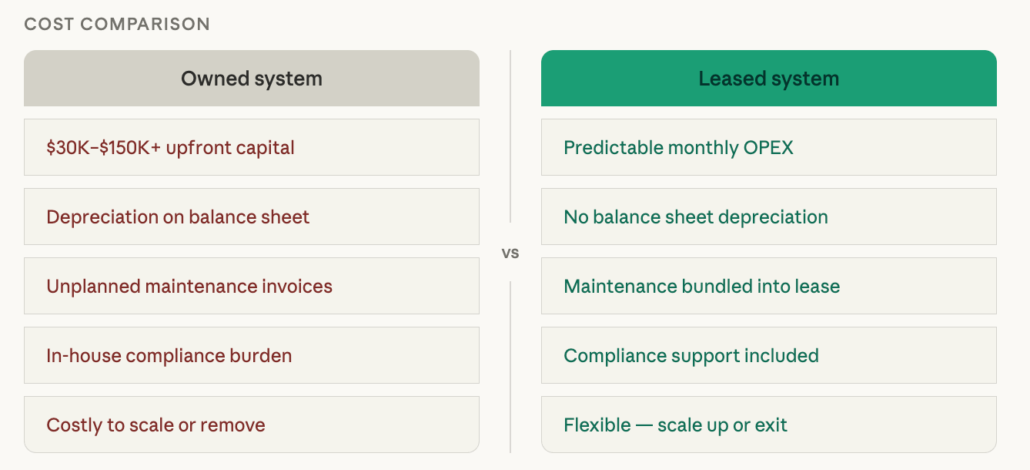
If capital budget is the reason your facility has not yet pre-positioned an emergency water treatment system, leasing can provide a practical alternative.
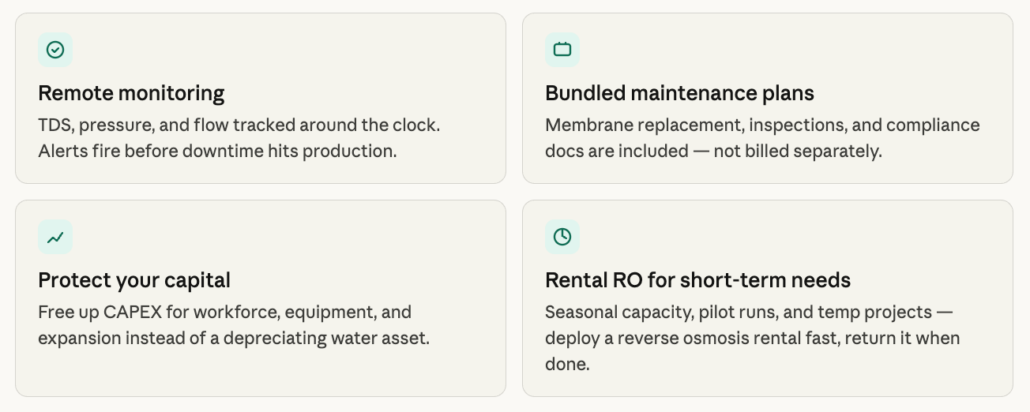
ADVANCEES water treatment leasing options can provide access to an operational system through a structured monthly agreement without requiring the same upfront capital investment as an outright purchase.
Depending on the agreement, leasing can offer:
- Lower upfront capital requirements
- Predictable monthly costs
- Access to available equipment
- Maintenance and technical support options
- Greater flexibility for seasonal or emergency preparedness
For resort operators, municipal utilities, and industrial facilities with capital budgets committed elsewhere, a leased ARKQUA system can provide a more accessible route to pre-storm water supply protection.
One Storm Is All It Takes
NOAA has consistently communicated an important message throughout hurricane season: a quieter overall forecast does not eliminate the risk to an individual coastal community. One storm making landfall near a populated area can cause severe disruption regardless of what the rest of the season looks like.
The facilities and municipalities that recover fastest from hurricane-related water supply failures are often those that planned for an independent treatment option before the storm developed.
Before the next storm forms, facilities should consider:
- Identifying primary and alternative source-water options
- Determining required daily treatment capacity
- Confirming backup power availability
- Reviewing containerized RO and seawater treatment options
- Evaluating leasing versus purchasing
- Confirming equipment availability and logistics requirements
Contact ADVANCEES today to confirm current ARKQUA stock availability, discuss system capacity options for your facility or community, and arrange pre-storm deployment before the peak of the 2026 hurricane season.


 ADVANCEES