
In any commercial or industrial water treatment system, the pump is the engine that makes everything else work. Without sufficient, consistent pressure, reverse osmosis membranes cannot operate at specification, pre-treatment systems cannot deliver adequate flow, and the entire treatment train underperforms regardless of how well every other component is specified. A pump skid system is how serious water treatment operations deliver that pressure reliably, safely, and in a format that integrates cleanly with the rest of the system.

If you are specifying a new water treatment system, upgrading an existing one, or troubleshooting pressure-related performance problems, understanding what a pump skid system is and what it does is an essential part of making the right infrastructure decision before Q4 budget cycles close.

What Is a Pump Skid System?

A pump skid system is a pre-engineered, skid-mounted assembly that integrates one or more pumps, associated pipework, valves, instrumentation, and controls onto a single structural frame. Rather than sourcing and installing pump components individually on site, a pump skid arrives as a complete, factory-assembled unit that connects directly to the water treatment system’s feed and discharge pipework.

The skid format, typically a welded steel or stainless steel baseframe, serves several practical purposes. It provides a rigid, level mounting platform for all components, simplifying installation on uneven or existing concrete pads. It keeps all associated pipework, valves, and instrumentation compact and organized rather than distributed across a large plant room footprint. And it allows the entire assembly to be factory-tested before shipment, so the unit arrives verified and ready to commission rather than requiring extensive on-site assembly and testing.

In water treatment applications, pump skid systems are used at multiple points in the treatment train, from raw water intake and pre-treatment feed through to high-pressure RO feed, permeate transfer, and product water distribution.

What Does a Pump Skid System Do in a Water Treatment Context?

The specific function of a pump skid system depends on where it sits within the treatment train. In commercial and industrial RO applications, the most critical pump skid role is delivering the precise feed pressure that RO membranes require to operate at their rated recovery and rejection specifications.

Brackish water RO membranes typically require feed pressures between 100 and 400 psi depending on feed water TDS and system recovery rate. Seawater desalination membranes operate at significantly higher pressures, from 800 to 1,200 psi. A pump skid system engineered for the specific pressure and flow requirements of your membrane array delivers that operating point consistently, with the flow control, pressure regulation, and protection features that prevent membrane damage from pressure surges, dry running, or over-pressure events.

Beyond RO feed duty, pump skids serve in:

  • Pre-treatment feed: Delivering consistent flow from raw water storage to multimedia filters, softeners, and chemical dosing stages.
  • Permeate transfer: Moving treated water from RO product storage to the point of use or final distribution.
  • Chemical dosing integration: Controlling antiscalant, biocide, and pH adjustment chemical injection at precise, flow-proportional rates.
  • Booster duty: Maintaining consistent pressure in distribution systems where elevation, distance, or demand variation would otherwise cause pressure fluctuation at the point of use.

Key Components of a Water Treatment Pump Skid System

A well-specified pump skid for water treatment duty includes more than just a pump and a frame. The components that surround the pump determine how reliably it operates, how easily it integrates with the control system, and how long it lasts in continuous industrial service.

Pump selection: Centrifugal, multistage centrifugal, and positive displacement pumps each suit different pressure and flow requirements. RO feed duty for brackish water applications typically uses stainless steel multistage centrifugal pumps rated for continuous high-pressure operation. Material selection, stainless steel for corrosive or high-purity applications, matters as much as hydraulic performance for long service life.

Pressure instrumentation: Inlet and outlet pressure gauges and transducers allow real-time monitoring of pump operating conditions and feed system performance. Low-pressure switches on the inlet protect the pump from dry-run damage when upstream supply is interrupted.

Flow control: Variable frequency drives (VFDs) allow pump speed to be adjusted to match the precise flow and pressure requirement of the RO system at different operating conditions, reducing energy consumption and extending pump service life compared to fixed-speed operation with throttle valve control.

Isolation and protection valves: Inlet isolation, outlet check valves, and pressure relief valves are standard components on a correctly specified water treatment pump skid. They protect both the pump and the downstream membrane system from pressure excursions and allow safe isolation during maintenance.

Skid frame and pipework: Welded stainless steel frames with stainless or UPVC pipework suit potable water, high-purity, and food-grade applications. Carbon steel frames suit raw water and non-contact duties where corrosion resistance at the frame level is less critical.

Why a Pump Skid System Outperforms Field-Assembled Alternatives

The alternative to a factory-assembled pump skid is sourcing pump components individually and having them installed on site by a contractor. For simple, low-pressure duties with minimal instrumentation, field assembly can be adequate. For the pressure levels, flow precision, and instrumentation requirements of commercial and industrial RO systems, it rarely is.

Factory assembly and testing deliver several advantages that field assembly cannot replicate consistently.

Performance verification before shipment. A factory-tested pump skid arrives with documented performance data confirming that it delivers the specified flow and pressure at the rated operating point. Field-assembled installations are commissioned on site, where identifying and correcting performance problems is significantly more time-consuming and expensive.

Compact, organized layout. A skid-mounted assembly keeps all associated components within a defined footprint, simplifying maintenance access, reducing the risk of field pipework errors, and making the installation easier to document and inspect.

Faster installation. Connecting a pre-assembled skid to existing feed and discharge pipework takes a fraction of the time required to field-assemble equivalent components from individual deliveries.

Single-source responsibility. When a pump skid system is supplied and tested by one provider, responsibility for performance is clear. Field-assembled installations distributed across multiple equipment suppliers and a site installation contractor create ambiguity about responsibility when performance problems arise.

Specifying the Right Pump Skid System for Your Water Treatment Application

Pump skid specification for water treatment duty starts with three parameters: the required flow rate, the required discharge pressure, and the feed water characteristics including temperature, TDS, and any corrosive species that influence material selection.

From those parameters, a correctly engineered pump skid delivers the operating point your system requires, with the protection features and control integration that industrial continuous-duty operation demands.

ADVANCEES pump skid systems are designed and specified for water treatment applications across the full range of commercial and industrial duties. Each system is matched to the specific pressure and flow requirements of the RO or treatment system it serves, including ADVANCEES commercial and industrial brackish water RO systems where pump skid integration is a core part of the overall system design.

Contact ADVANCEES today to discuss your pump skid requirements and receive a specification recommendation based on your system’s feed conditions, pressure requirements, and daily flow demand. Our design and consultancy team can review your full treatment train and ensure the pump system is correctly matched to every stage of the process.
Commercial and industrial facilities rely on reverse osmosis (RO) systems to produce high-purity water for manufacturing, food and beverage processing, boiler feed applications, pharmaceuticals, and countless other uses. As water treatment requirements continue to grow more complex, one component has become increasingly vital for system performance: the pump skid.

A well-designed pump skid system integrates the pumps, instrumentation, valves, piping, and controls into a single, pre-engineered assembly. Instead of piecing together individual components on-site, pump skids deliver a turnkey solution that dramatically improves RO performance, energy efficiency, and long-term reliability.

At Advancees, our PS Pump Skids are engineered specifically for commercial and industrial RO systems, structured to reduce installation time, simplify operation, and extend the lifespan of downstream components.

Why Pump Skids Are Critical for RO System Efficiency

1. Consistent Pressure for Optimal Membrane Performance

Reverse osmosis membranes require precise, stable pressure to function properly. Even minor fluctuations can reduce permeate quality, increase energy usage, and shorten membrane life.

A pump skid ensures:

  • Continuous, stable pressure

  • Smooth flow delivery with minimal pulsation

  • Correct hydraulic performance across varying demand levels

This stability helps protect membranes from unnecessary stress, ultimately lowering operational costs.

2. Plug-and-Play Design Reduces Installation Time

Traditional RO system installation involves sourcing pumps, valves, pipe fittings, gauges, and control systems separately. This increases labor hours, creates compatibility issues, and raises the risk of installation errors.

Pump skids eliminate that complexity.

Because the entire assembly is pre-fabricated, tested, and packaged, contractors benefit from:

  • Faster startup

  • Fewer field modifications

  • Reduced integration errors

  • Lower installation costs

This “ready-to-run” format is a major reason pump skids are trending across the water treatment industry.

3. Improved System Monitoring and Automation

When paired with a centralized control system, pump skids give operators clearer visibility into performance metrics like flow, pressure, temperature, and pump status.

A dedicated control panel allows operators to:

  • Automate pump sequencing

  • Monitor real-time system health

  • Integrate alarms and safety protections

  • Reduce manual adjustments

  • Improve overall system uptime

Many facilities are moving toward smart automation, and a pump skid combined with a proper control panel makes this transition seamless.

Where Pump Skids Fit Within a Complete RO Treatment Train

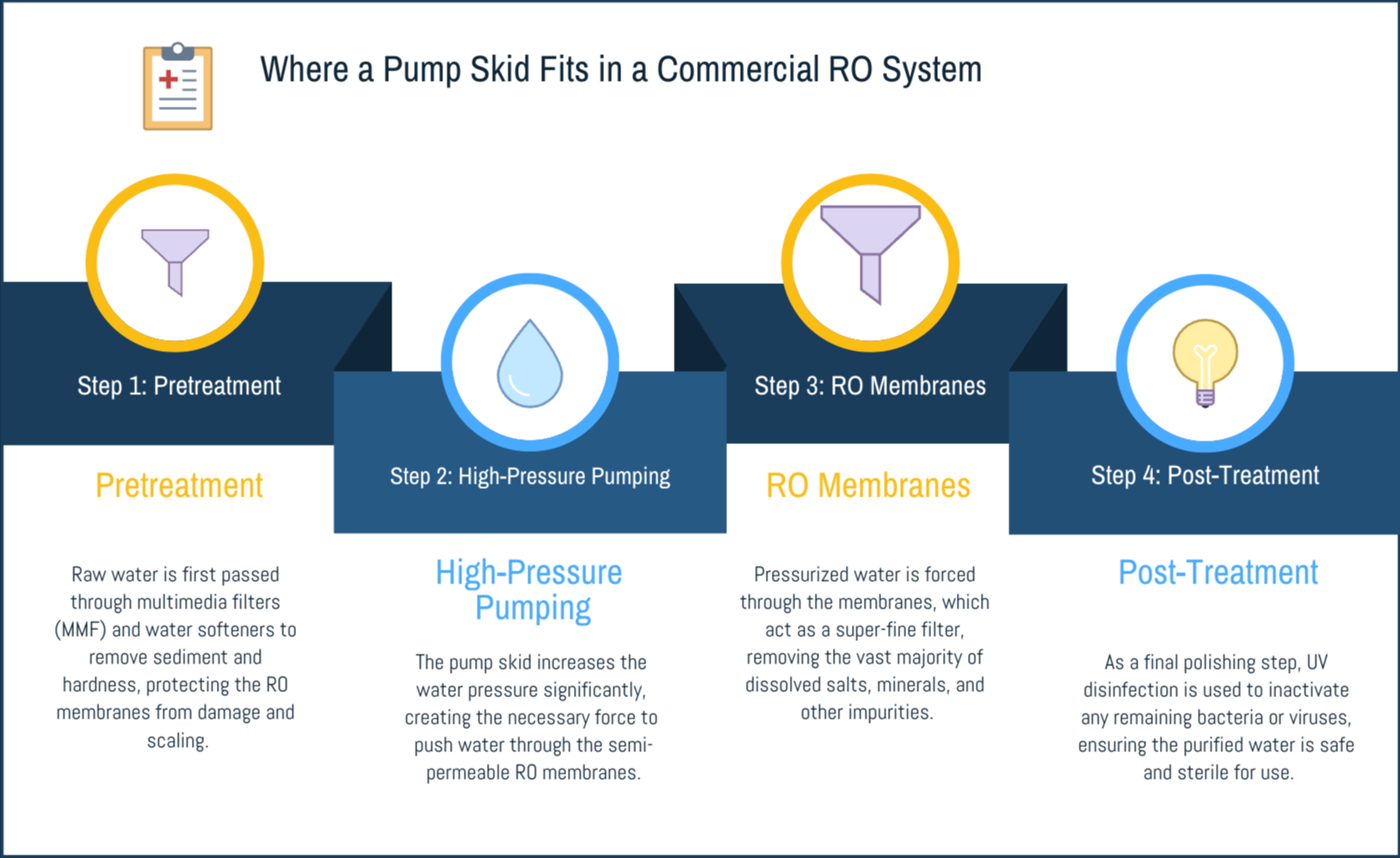
Where a pump skit fits in a commercial RO system

Pump skids are only one part of a larger water treatment process. To understand their impact, it helps to look at their placement within the system.

A typical commercial RO setup includes:

1. Pretreatment Stage

Before water reaches the pump skid, it must pass through pretreatment equipment that protects downstream components.

Key pretreatment technologies include:

Proper pretreatment is essential because solids, scale, or organics can damage high-pressure pumps and cause membrane fouling. A pump skid works most efficiently when fed high-quality water from a stable pretreatment system.

2. High-Pressure Pumping (Where the Pump Skid Operates)

Once pretreatment is complete, the pump skid drives water into the RO membranes at the correct pressure. This is the heart of the system and directly impacts:

  • Production rate

  • Permeate quality

  • Membrane life

  • Energy usage

With a dedicated skid, the entire pumping operation becomes easier to manage, maintain, and optimize.

3. Post-Treatment and Disinfection

After water passes through the RO membrane, post-treatment steps may be required depending on the application.

A common choice is ultraviolet water treatment, which eliminates microbiological contamination without chemicals.

UV disinfection is especially valuable when:

  • Storing water in tanks

  • Supplying water for food or beverage production

  • Meeting NSF/ANSI safety standards

Together, pretreatment, pump skids, and post-treatment form a complete, efficient RO water purification process.

Energy Efficiency: A Major Advantage of Modern Pump Skid Systems

Commercial RO systems often operate for long periods, so energy efficiency is a key factor in long-term operating costs. Pump skids help improve efficiency through:

  • Proper pump sizing

  • Efficient hydraulic layouts

  • Reduced friction losses

  • Optional VFD (variable frequency drive) integration

  • Lower electrical demand

By optimizing flow and pressure, facilities see reduced energy costs and extended equipment life—two major advantages for high-demand applications.

Lower Maintenance & Minimal Downtime

A consolidated skid reduces the number of individual components that require manual checks. Maintenance teams benefit from:

  • Clearly labeled valves and gauges

  • Organized piping

  • Easy access to pumps and fittings

  • Fewer connection points that could leak or fail

Many facilities also appreciate the compact footprint, which saves space in crowded mechanical rooms.

Why Facilities Are Transitioning Away from Custom-Built Pump Installations

Historically, pump systems were constructed on-site using standalone pumps, scrap skids, loose wiring, and manually assembled piping. This approach comes with several challenges:

  • Increased risk of leaks

  • Difficulty troubleshooting

  • Poor component compatibility

  • Extended downtime during repairs

  • Traditional systems lack standardization

Pre-engineered pump skids solve all of these issues by offering a consistent, factory-tested package built to industry standards.

Final Thoughts: Pump Skids Make RO Systems More Reliable and More Efficient

As commercial and industrial RO systems continue to evolve, pump skid systems have become essential for achieving stable operation, energy savings, and dependable water quality. When combined with strong pretreatment, smart controls, and proper post-treatment, pump skids help facilities operate more efficiently while minimizing maintenance and downtime.

ADVANCEES offers fully engineered PS Pump Skids specifically designed for RO applications, providing the reliability and performance needed for high-demand environments.

Water treatment facilities require efficient, scalable, and reliable reverse osmosis (RO) systems to meet their purification demands. Among the most commonly used configurations are skid-mounted RO plants and containerized RO systems. Each option offers unique benefits depending on operational needs, space availability, mobility, and environmental conditions.

This guide explores the differences between skid plants vs. containerized RO systems, helping businesses and industries determine the best solution for their water treatment requirements.


What Are RO Skid Plants?

RO skid plants are modular reverse osmosis systems built on a compact, open-frame skid that houses key components such as pumps, membranes, and control panels. These systems are pre-assembled and tested before installation, allowing for easy integration into an existing facility.


Key Features of Skid-Mounted RO Plants

  • Fully pre-engineered and assembled for plug-and-play installation
  • Open-frame design allows for easy access to components for maintenance
  • Can be integrated into existing infrastructure with minimal modifications
  • Available in customizable sizes to meet different production capacities
  • Ideal for facilities with permanent water treatment needs


Advantages of RO Skid Plants

  1. Cost-Effective Installation – Since the system arrives pre-assembled, installation costs and setup time are reduced.
  2. Customizable – Can be designed to fit specific flow rates and water treatment needs.
  3. Easier Maintenance – Open-frame design allows for quick access to components for servicing and repairs.
  4. Scalability – Additional skid units can be installed as water demand grows.


Best Applications for RO Skid Plants

  • Industrial and manufacturing facilities with fixed installation space
  • Municipal water treatment plants requiring large-scale water purification
  • Agricultural irrigation systems needing consistent and high-capacity water supply
  • Power plants and refineries requiring specialized water filtration


What Are Containerized RO Systems?

Containerized RO systems are self-contained water treatment plants built inside a standard ISO shipping container. These units include all necessary components, such as filtration systems, pumps, and electrical panels, making them a fully mobile and turnkey solution.


Key Features of Containerized RO Systems

  • Housed inside 20-ft or 40-ft containers for easy transportation and deployment
  • Pre-assembled and pre-tested to minimize setup time
  • Equipped with climate control, insulation, and protective casing for harsh environments
  • Designed for remote locations, emergency water supply, and temporary projects
  • Can be configured with solar panels for off-grid operation


Advantages of Containerized RO Systems

  1. Portability – Can be relocated as needed, making it ideal for temporary or mobile applications.
  2. Minimal On-Site Installation – Systems arrive fully enclosed and ready to operate, reducing installation time.
  3. Weather Protection – Built to withstand extreme climates, ensuring durability in remote locations.
  4. Rapid Deployment – Ideal for disaster relief, military applications, and emergency water supply.


Best Applications for Containerized RO Systems


Skid Plants vs. Containerized RO Systems: Which One Is Right for You?

When choosing between skid-mounted RO plants and containerized RO systems, it’s essential to consider factors such as mobility, installation environment, and operational flexibility.

Factor RO Skid Plants Containerized RO Systems
Mobility Fixed installation, not easily movable Fully mobile, can be relocated as needed
Installation Requires integration into an existing facility Arrives pre-assembled and ready for quick deployment
Maintenance Access Open-frame design for easy servicing Enclosed system with protected components
Weather Resistance Requires an indoor or covered area Fully enclosed and weather-resistant
Use Case Permanent facilities with high water demands Remote sites, emergency relief, or mobile applications
Customization Fully customizable to fit facility needs Standardized container sizes with optional add-ons


Final Considerations: Making the Right Choice

  • Choose RO skid plants if:
    • You need a long-term water treatment solution at a fixed location
    • Your facility has existing infrastructure for integration
    • Custom configuration is essential for your water treatment needs
    • Easy maintenance access is a priority
  • Choose containerized RO systems if:
    • You need a portable and rapidly deployable water treatment unit
    • Your operation is off-grid or in a remote location
    • You require climate-controlled and weather-resistant protection
    • Quick setup and minimal on-site construction are necessary
Both skid-mounted and containerized RO systems offer efficient and reliable water treatment, but selecting the best option depends on your industry’s specific needs, mobility requirements, and infrastructure limitations.
For expert guidance on selecting the right RO system, contact ADVANCEES today to discuss your project requirements and explore our custom water treatment solutions.