
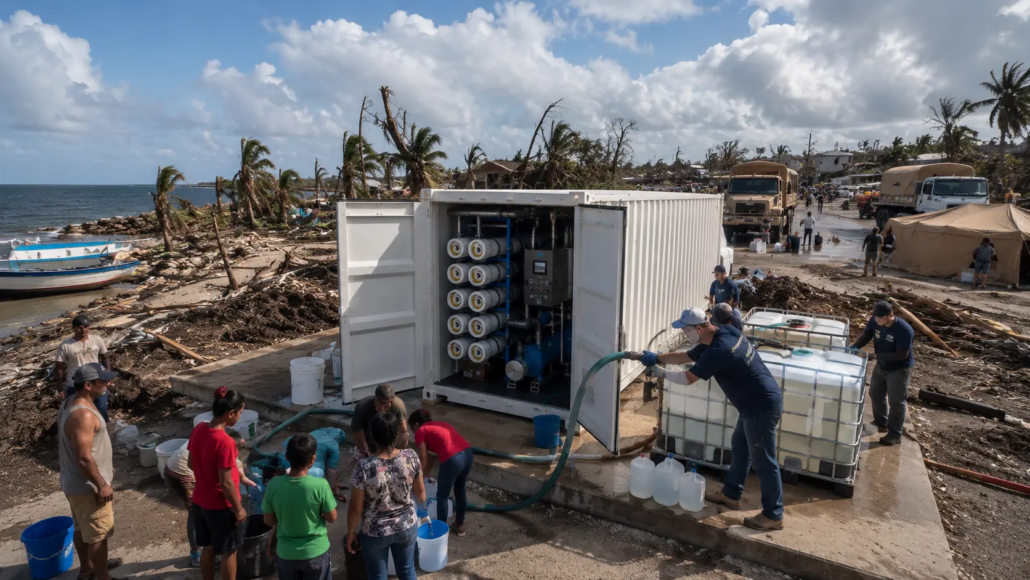
When a disaster strikes a coastal or island community, the cruel irony is that water is everywhere and none of it is safe to drink. Floodwaters contaminate wells. Earthquakes rupture distribution lines. Storm surge pushes saltwater into freshwater aquifers. In many cases, the affected area is surrounded on all sides by the ocean, an essentially unlimited water source that requires the right technology to make it safe.
For NGOs, UN agencies, government emergency response teams, and disaster relief organizations operating in coastal and island disaster zones, the operational question is not whether a water source exists. It is how quickly a containerized desalination system can be deployed to treat it.
Venezuela’s June 2026 earthquakes brought this question into sharp focus. A country already experiencing a near collapse of its water infrastructure, with up to 80 percent of its population lacking reliable access to clean water, was hit by the strongest seismic event it had seen in more than a century. Coastal communities lost what remained of their water supply infrastructure overnight.
For response organizations on the ground, the challenge was immediate: how do you deliver safe water to a population of tens of thousands when there is no functioning treatment plant, no reliable grid power, and no time to build anything permanent?
The answer is a containerized desalination system for humanitarian response that is available in stock and deployable within days of the decision to act.
What Containerized Desalination Means in a Field Context
Containerized desalination refers to a reverse osmosis or seawater RO treatment system that is fully integrated, tested, and housed within a standard ISO shipping container before it leaves the factory.
The system typically includes:
- High-pressure pumps
- Reverse osmosis membrane arrays
- Pretreatment equipment
- Control panels and monitoring systems
- Product water storage connections
Every component is installed, commissioned, and verified inside the container before delivery.
This distinction matters enormously in a humanitarian response context. A system that arrives as a collection of components requiring on-site assembly, pipework fabrication, and specialist commissioning is not a rapid deployment solution. It is a construction project in a disaster zone.
A factory-tested containerized desalination system for humanitarian response arrives ready to produce water. Connect it to a seawater or brackish water feed source, connect it to a power supply, and the system can begin operating.
This means:
- No on-site assembly
- No civil works
- No pipework fabrication
- No permanent installation
- No large specialist engineering team required for setup
The ADVANCEES ARKQUA containerized RO and seawater desalination systems are built to this standard. Every unit leaves the ADVANCEES facility tested and verified. Every unit arrives at the deployment site ready to run.
How Many People Can a Containerized Desalination System Serve?
Daily water output requirements for humanitarian response are calculated on a per-person basis. The Sphere Handbook, the established standard for humanitarian minimum requirements, sets a minimum of 15 liters per person per day for basic survival needs, including drinking, cooking, and basic hygiene.
For a more comprehensive humanitarian response that includes sanitation, medical facilities, and food preparation, daily per-person requirements typically rise to 35 to 50 liters.
Using these benchmarks, the population a containerized desalination system can serve depends directly on its daily output capacity:
- 5,000 GPD: Approximately 19,000 liters per day, enough to meet basic survival needs for up to 1,200 people or more comprehensive needs for approximately 380 to 540 people.
- 10,000 GPD: Approximately 37,900 liters per day, enough to meet basic needs for up to 2,500 people or more comprehensive needs for approximately 750 to 1,000 people.
- 50,000 GPD: Approximately 189,000 liters per day, enough to meet basic needs for up to 12,600 people or more comprehensive needs for approximately 3,800 to 5,400 people.
For larger affected populations, multiple ARKQUA units can be deployed in parallel at a central distribution point or positioned across several sites within the affected area. This allows total daily output to scale with the response requirement without major additional infrastructure investment.
The ADVANCEES seawater desalination range includes multiple output capacities within this operational spectrum. Matching the right capacity to the specific population being served is a critical step in the procurement process, and ADVANCEES engineers can assist before deployment is finalized.
Why In-Stock Availability Is the Critical Differentiator
In humanitarian response, the difference between a system that is available immediately and one that requires a production lead time is measured by the number of days a population goes without safe water.
Waterborne disease outbreaks, including cholera, typhoid, and hepatitis A, can develop within days when a population is forced to rely on contaminated water sources. The WHO estimates that diarrheal diseases, many of which are waterborne, kill approximately 1.6 million people annually, with the highest concentration of deaths occurring in post-disaster and low-income settings.
Manufacturing lead times for custom water treatment systems typically range from 8 to 16 weeks under normal production conditions. In the weeks following a major disaster, supply chain disruptions, port closures, and freight congestion can extend those timelines even further.
For response organizations planning a deployment several months after an event, a manufactured-to-order system may still arrive in time to be useful. For organizations responding to an acute crisis in the first days and weeks, it will not.
ADVANCEES ARKQUA containerized desalination systems are available in stock for immediate deployment. Learn more about ARKQUA 200 and ARKQUA 500 rental and leasing options.
For humanitarian response coordinators who need to confirm availability and begin dispatch within 24 to 48 hours of a procurement decision, in-stock status is not simply a preference. It is the primary selection criterion.
Operational Simplicity in Field Conditions
Humanitarian field environments impose operational constraints that standard commercial water treatment systems are not designed to accommodate. Field teams are typically multidisciplinary and may be managing medical care, logistics, community engagement, distribution, and protection functions at the same time.
Dedicating trained personnel exclusively to water treatment system operation is rarely practical.
ARKQUA systems are designed for straightforward operation by personnel without specialist water treatment backgrounds. Automatic controls manage the treatment process continuously and monitor:
- Feed water quality
- System pressure
- Permeate output
- Operating conditions
Under normal conditions, the system does not require constant manual adjustment. Routine maintenance tasks, including filter replacement and basic cleaning, are straightforward and clearly documented for field operators.
For response organizations requiring remote technical assistance, ADVANCEES can provide remote monitoring support. This allows engineers to observe system performance and guide field teams through operational adjustments without requiring an on-site technical visit.
Leasing and Flexible Procurement for Humanitarian Budgets
Humanitarian response funding operates through approval processes, donor requirements, and budget structures that do not always align with traditional capital procurement timelines.
For organizations working within UN cluster funding frameworks, bilateral donor grants, or emergency pooled funds, accessing a fully operational containerized desalination system through a lease or rental arrangement provides a more flexible path to rapid deployment.
ADVANCEES leasing and rental options for water treatment systems allow response organizations to access in-stock ARKQUA units through a structured monthly payment model. Maintenance support can also be included, removing the need for a large upfront capital commitment.
For procurement officers operating within humanitarian funding constraints, this structure removes the capital barrier to deploying the right system at the right time.
The Window Between Disaster and Disease Is Measured in Days
Every humanitarian response organization that has operated in the field after a major disaster understands that the window between the event and the onset of waterborne disease is short.
Venezuela’s situation, compounded by years of infrastructure deterioration and accelerated by the June 2026 earthquakes, is an extreme example of a risk that exists at every coastal and island disaster site.
A containerized desalination system for humanitarian response that is in stock, fast to deploy, simple to operate, and available in the right capacity is not merely a logistical convenience. It can determine whether clean water reaches an affected population in time.
Contact ADVANCEES today to confirm current ARKQUA stock availability, discuss system capacity options for your deployment, and explore leasing or procurement structures that fit your organization’s funding framework.


 ADVANCEES
