
When a water supply fails, whether from a hurricane, earthquake, flood, or infrastructure collapse, the procurement decision that follows is one of the most consequential an operations manager, NGO coordinator, or municipal emergency planner will ever make under pressure. The wrong system, or the right system specified incorrectly, can delay clean water delivery by weeks in an environment where days matter.
The challenge is that not every water treatment system marketed as suitable for emergency use is actually ready for rapid field deployment. Many commercial RO and filtration systems are engineered for fixed installation in stable environments with grid power, permanent pipework, and trained operators on site. In an emergency, none of those conditions can be assumed.
This checklist is designed for procurement managers, NGO project coordinators, and emergency planners who need a clear, practical framework for evaluating whether a water treatment system is genuinely ready for emergency deployment before committing to a purchase or lease.
Checklist Item 1: Is the System Available from Stock Right Now?
This is the first question that determines everything else. A system that requires 8 to 16 weeks of manufacturing lead time is not an emergency deployment solution, regardless of its technical specifications. In a genuine emergency, the gap between when clean water is needed and when it can be delivered is measured in days, not months.
Before evaluating any other feature, confirm whether the system you are considering is physically available in stock and ready to ship. If the answer is anything other than yes, move to a supplier that holds inventory.
ADVANCEES ARKQUA systems are available in stock for immediate deployment. Explore ARKQUA 200 and ARKQUA 500 rental and leasing options. There is no manufacturing queue or production delay. The system exists, it is tested, and it can be dispatched.
Checklist Item 2: Does It Require Civil Works or Permanent Installation?
A standard commercial water treatment system typically requires concrete pads, fixed pipework connections, electrical infrastructure, and, in some cases, structural housing. Installing these in an emergency environment, particularly in post-disaster or remote field conditions, is often impossible. Civil contractors are unavailable, materials are inaccessible, and the timeline for civil works eliminates the speed advantage of having a system at all.
A true emergency-ready water treatment system arrives complete and self-contained. It connects to a feed water source and a power supply and begins operating without any permanent installation work.
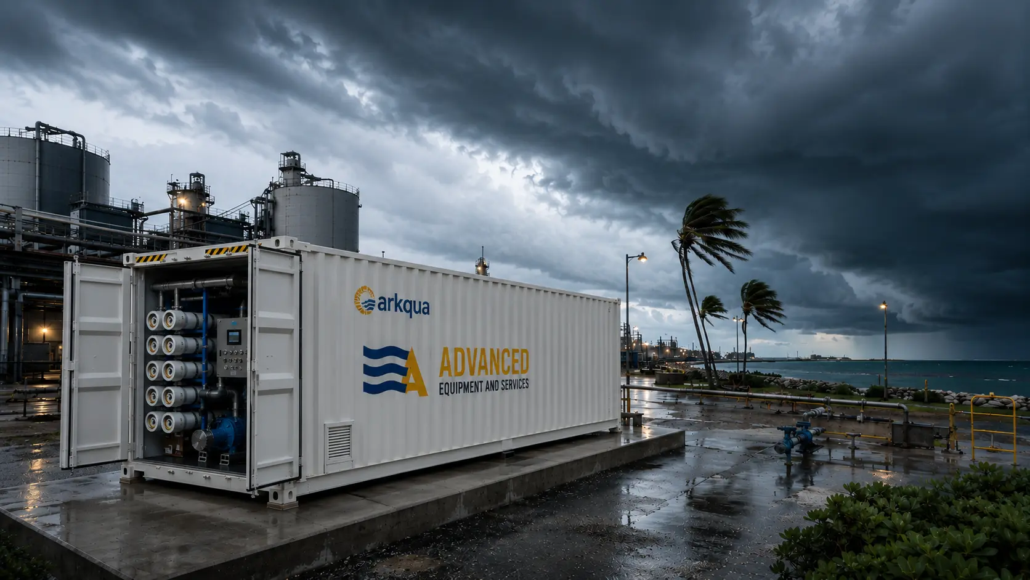
The ARKQUA containerized RO and desalination range is housed in a standard ISO shipping container, self-contained, and ready for connection when it arrives on site. No civil works, permanent installation, or dependency on infrastructure that may not exist is required.
Checklist Item 3: How Fast Can It Be Installed and Operational?
Fast deployment is not just about shipping time. It also includes how quickly a system can be commissioned and begin producing treated water after it reaches the deployment site. A system that takes three days to install and commission after arrival is not operational on day one.
Evaluate the full timeline from delivery to the first treated water output. For a genuine emergency deployment system, that window should be measured in hours, not days.
ARKQUA units are designed for fast deployment and straightforward installation in demanding field environments. The containerized format means the unit arrives in its operating configuration. Connecting the feed water and power completes the installation. For most deployments, the system can begin producing treated water on the same day it arrives.
Checklist Item 4: Can Non-Specialist Personnel Operate It?
Emergency deployment environments rarely include dedicated water treatment engineers. Field teams typically consist of humanitarian logistics staff, military personnel, municipal emergency workers, or community volunteers who have not received specialized water treatment training.
A system that requires specialist knowledge to operate may not function correctly when a trained operator is unavailable. Automatic controls, clear operational indicators, and straightforward maintenance requirements are not optional features for an emergency deployment system. They are essential specifications.
ARKQUA systems operate automatically, with controls that manage the treatment process without requiring continuous technical input from the operator. Routine maintenance is straightforward and does not require specialist tools or engineering expertise.
For additional assistance during commissioning or remote monitoring, ADVANCEES offers design and consultancy services to help ensure the system performs correctly from day one.
Checklist Item 5: Does It Offer Multiple Capacity Options?
Emergency water requirements vary significantly depending on the size of the affected population. A system sized for a 200-person field hospital is not the right specification for a 5,000-person refugee camp. Likewise, a large-capacity industrial system may not be practical for a rural community of 500 people.
An emergency deployment supplier should offer multiple system capacities so the response can be matched to the population being served. An undersized system leaves people without adequate water. An oversized system creates unnecessary logistical complexity and cost.
The ARKQUA range covers multiple daily production capacities, allowing procurement teams to select the appropriate system for each deployment’s population and water demand. Learn more about ADVANCEES small desalination systems for fast deployment.
When demand exceeds the output of one unit, multiple ARKQUA systems can operate in parallel without requiring extensive additional infrastructure.
Checklist Item 6: Is It Built for Harsh Field Conditions?
A standard commercial water treatment system is engineered for a climate-controlled plant room or purpose-built facility. It may not withstand transport across damaged roads, exposure to coastal humidity, tropical heat, or the physical stress of repeated deployment and relocation.
An emergency deployment system must operate reliably under those conditions. Its housing, component protection, and engineering must account for field environments rather than controlled plant settings.
The ARKQUA containerized format provides inherent structural protection. The ISO shipping container shields internal components during transport and field operation, protecting the system from environmental conditions common to post-disaster and remote deployment sites. These systems are engineered for dependable operation in demanding environments.
Checklist Item 7: Can It Treat the Water Source Available at the Deployment Site?
This item is frequently overlooked in emergency procurement, often with costly consequences. A system designed for brackish groundwater cannot automatically treat seawater. Likewise, a system sized for low-TDS surface water may not handle the elevated dissolved solids found in sources affected by flooding or saltwater intrusion.
Before specifying a system, confirm the TDS range and contamination profile of the water source available at the deployment site.
Potential source-water conditions may include:
- Brackish groundwater with elevated dissolved minerals
- Seawater or coastal wells affected by saltwater intrusion
- Flood-impacted surface water containing sediment and biological contaminants
- Temporary hauled water with variable quality
In post-hurricane coastal environments, freshwater wells may become contaminated with seawater, requiring desalination-grade treatment instead of standard brackish water RO. In inland flood scenarios, the primary concern may be biological or chemical contamination rather than salinity.
ADVANCEES ARKQUA systems are available in reverse osmosis and seawater desalination configurations, covering sources ranging from brackish groundwater to full seawater TDS concentrations. Selecting the correct configuration for the available source water is a critical specification decision that ADVANCEES engineers can support before procurement is finalized.
The Summary Checklist
Before committing to an emergency water treatment system, confirm that it meets all of the following requirements:
- Available from stock: The system can be dispatched immediately without a manufacturing delay.
- No civil works required: The unit is self-contained and ready for connection when it arrives.
- Fast commissioning: The system can begin producing treated water within hours of delivery.
- Simple operation: Non-specialist personnel can manage routine operation in the field.
- Multiple capacity options: The system can be matched to the population or facility being served.
- Built for harsh field conditions: The equipment is protected during transport and outdoor operation.
- Correct treatment configuration: The system is designed for the source water available at the deployment site.
If a system does not meet every item on this checklist, it is not ready for genuine emergency deployment, regardless of how it is marketed.
ARKQUA Systems Meet Every Item on This Checklist
ADVANCEES ARKQUA containerized RO and desalination systems are in stock, self-contained, fast to commission, straightforward to operate, available in multiple capacities, built for field conditions, and configurable for both brackish water and seawater sources.
Contact ADVANCEES today to discuss which ARKQUA system capacity and configuration is right for your emergency deployment requirements. Our team can also confirm current stock availability and dispatch timelines for your location.


 ADVANCEES
