
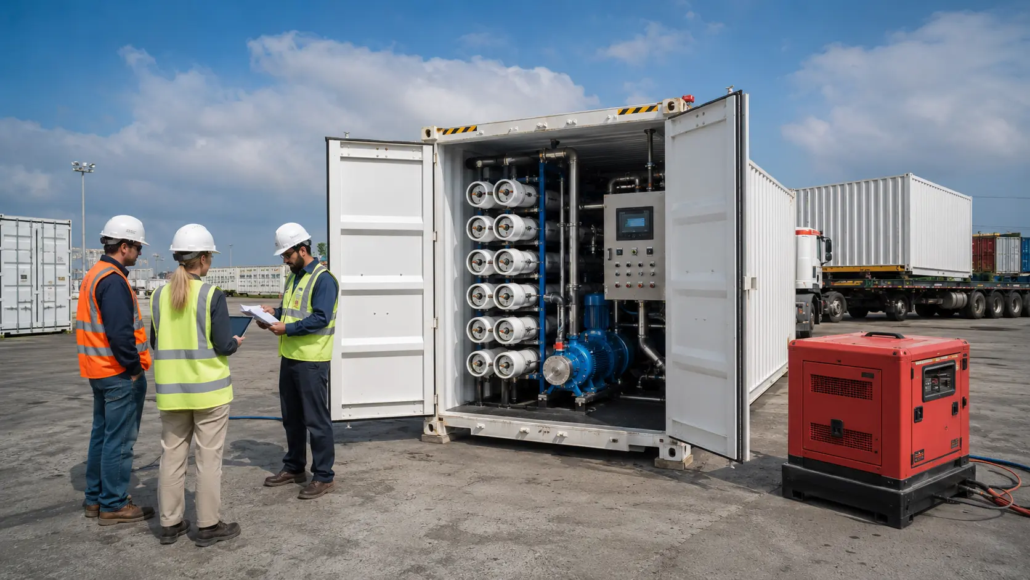
Procuring a water treatment system for emergency deployment is a fundamentally different decision from procuring one for a fixed commercial or industrial installation. The performance specifications that matter in a stable facility environment, membrane rejection rates, recovery ratios, and energy consumption benchmarks, remain relevant. However, in a disaster zone, those specifications are secondary to a set of operational requirements that determine whether the system can be deployed at all, whether it will function without the infrastructure it was designed to rely on, and whether the field team operating it can keep it running without specialist support.
For procurement officers, military logistics teams, and large NGO supply chain managers, the consequences of specifying the wrong system are measured in deployment delays, field failures, and populations that go without safe water longer than necessary.
This post defines the six non-negotiable features that separate a genuinely deployable emergency RO system from a commercial unit that cannot perform in a disaster environment, with clear explanations of why each feature matters operationally and how to verify it before committing to a procurement decision.
Feature 1: Factory-Integrated, Self-Contained Design
An emergency RO system that arrives as a set of components requiring on-site assembly is not a rapid deployment solution. It is a construction project in a disaster zone, and disaster zones do not have the skilled labour, tools, or stable working conditions that on-site system integration requires.
A factory-integrated system means that every major component is installed, connected, and tested inside its housing before it leaves the factory, including:
- High-pressure pumps
- Reverse osmosis membrane arrays
- Pre-treatment equipment
- Control panels and instrumentation
- Internal pipework and connections
The system arrives as a single, complete, operational unit. The primary connections required on site are the feed water inlet, product water outlet, concentrate discharge, and power supply.
For procurement teams specifying systems for multi-site or multi-country deployment frameworks, factory integration also means that every unit in a fleet can maintain a consistent configuration, simplifying spare parts management, operator training, and remote technical support across multiple deployment locations simultaneously.
The ADVANCEES ARKQUA containerized RO and desalination systems are factory-integrated and tested before shipment. Each unit arrives in its operating configuration, self-contained within a standard ISO shipping container, and ready to produce treated water within hours of reaching the deployment site.
Feature 2: Transport Compatibility with Standard Logistics Infrastructure
An emergency RO system that cannot be moved efficiently through the available logistics network is not deployable regardless of its technical specifications. In disaster response environments, logistics infrastructure is often severely constrained. Ports may be operating at reduced capacity, roads may be damaged, and air freight may be the only viable route to remote or island sites.
A system housed in a standard ISO shipping container provides several logistical advantages:
- Compatibility with commercial ports and standard container-handling equipment
- Transportation by standard flatbed trucks without specialized vehicles
- Potential transport by oversized cargo aircraft when road or sea routes are unavailable
- Ability to remain inside the container as its operating housing after deployment
Systems that require specialist transport equipment, non-standard lifting arrangements, or dedicated freight handling introduce logistics dependencies that increase cost, extend timelines, and create single points of failure in the supply chain.
For procurement teams managing multi-location deployments across challenging geographies, ISO container compatibility is a fundamental logistics requirement, not an optional convenience.
Feature 3: Power Flexibility and Grid Independence
In a disaster zone, grid power is the infrastructure most likely to be unavailable, unreliable, or operating at reduced voltage and frequency. An emergency RO system that requires stable grid power to operate is a system that may not function on day one, day two, or day three of a deployment in the environments where it is most needed.
A deployable emergency RO system should be configurable for multiple power sources, including:
- Diesel generator sets for emergency field deployments
- Solar photovoltaic systems with battery storage for off-grid or extended deployments
- Grid power where electrical infrastructure remains available and stable
Systems that can accommodate different power configurations provide greater operational flexibility across deployment scenarios.
When evaluating power specifications, procurement teams should confirm:
- Input power requirements under full operating load
- Generator capacity required for reliable operation
- Compatibility with available site power
- Protection of control electronics against voltage fluctuations and power interruptions
ADVANCEES engineers provide full technical specifications for ARKQUA power requirements and can advise on generator sizing and solar hybrid configurations for specific deployment sites through our RO plant design and consultancy services.
Feature 4: Feed Water Flexibility Across Source Types
Disaster environments are rarely predictable in terms of what water source will be available at the deployment site. A system specified for brackish groundwater may arrive at a coastal site where the groundwater has been contaminated with seawater following storm surge, requiring desalination-grade treatment. A system specified for surface water may be deployed to a site where the only available source is a tidal estuary with variable salinity.
A procurement framework for emergency RO systems should account for different potential source-water conditions, including:
- Brackish groundwater
- Coastal wells affected by saltwater intrusion
- Full-salinity seawater
- Surface water with variable salinity
- Tidal or estuarine water sources
Brackish water RO configurations may be appropriate for source water up to approximately 12,000 ppm TDS, while seawater desalination configurations are designed to treat full-salinity seawater in the range of approximately 30,000 to 45,000 ppm TDS.
Having both configurations available within the same product family can simplify training, spare parts management, and technical support across a mixed deployment fleet.
The ADVANCEES ARKQUA range covers both configurations within the same containerized product family. Procurement teams can specify a mix of brackish water and seawater desalination systems within a deployment framework, with consistent operating procedures and compatible equipment across the fleet.
Feature 5: Operator-Independent Automatic Control
Field operators in emergency response environments are not always water treatment engineers. They may be logistics coordinators, community health workers, military personnel, or municipal emergency workers who have been assigned water system operation as one of multiple responsibilities in a high-pressure field environment.
Expecting these personnel to manually monitor and adjust system parameters continuously is not a realistic operational assumption.
An emergency RO system should include automatic controls capable of managing essential treatment functions, such as:
- Automatic feed pressure regulation
- Membrane protection shutdowns during unsafe operating conditions
- Automated flush cycles to help protect membrane performance
- Clear alarm indicators communicating system status
- Continuous monitoring of critical operating parameters
Beyond daily operation, maintenance requirements should also be achievable by non-specialist personnel in the field.
Common maintenance tasks should include straightforward procedures such as:
- Filter cartridge replacement
- Chemical dosing replenishment
- Routine inspections
- Basic system cleaning
These procedures should require minimal specialized equipment and be supported by clear operational documentation.
ARKQUA systems include automatic controls that manage continuous operation without specialist oversight, and maintenance procedures are designed for execution by field personnel with basic technical competency. For deployments requiring remote technical monitoring, ADVANCEES provides connectivity options that allow engineers to observe system performance and advise field operators without requiring on-site visits.
Feature 6: In-Stock Availability with Verified Dispatch Capability
This feature is listed last because it is the one that cannot be compensated for by any other specification. A system that meets every technical requirement on this list but requires a 12-week manufacturing lead time is not available for emergency deployment. It is available for planned deployment three months from now, which is a fundamentally different procurement scenario.
For emergency procurement, teams should verify three things before moving forward:
- Physical availability: The required system actually exists in inventory.
- Correct capacity: The available unit can meet the deployment’s required daily water production.
- Dispatch capability: The supplier can prepare and release the equipment within the required emergency timeline.
In-stock availability means the system physically exists, has been factory-tested, and can be loaded for dispatch within 24 to 72 hours of a confirmed procurement decision. For procurement teams operating under emergency response timelines, verifying in-stock status before initiating any other stage of the procurement process is the single most important qualification step.
Verifying in-stock status also means confirming the available capacities in stock, not just whether any unit is available. A system in stock at the wrong output capacity for your population requirement is not the right system regardless of its availability.
ADVANCEES ARKQUA systems are maintained in stock across multiple output capacities and are available for immediate dispatch. Explore ARKQUA 200 and ARKQUA 500 rental and leasing options. Current stock status and confirmed dispatch timelines can be verified directly with the ADVANCEES team before procurement is finalized.
Specifying the Right Emergency RO System for Your Deployment
Every emergency deployment is different in terms of source water quality, population size, logistics constraints, power availability, and operator capability. A system specification that is correct for one deployment scenario may be inadequate for another.
The six features defined above should remain central to the procurement process:
- Factory-integrated and self-contained construction
- Compatibility with standard transportation infrastructure
- Flexible and reliable power options
- Correct configuration for available source water
- Automatic controls suitable for field operation
- Verified in-stock availability and dispatch capability
The specific configuration, capacity, and ancillary equipment required will vary by deployment.
ADVANCEES provides technical specification support for procurement teams evaluating ARKQUA systems for emergency deployment frameworks, multi-unit fleet procurement, and single-site rapid response requirements.
Contact ADVANCEES today to discuss your deployment parameters, confirm current stock availability and capacity options, and receive technical recommendations for your specific operational requirements.


 ADVANCEES
