
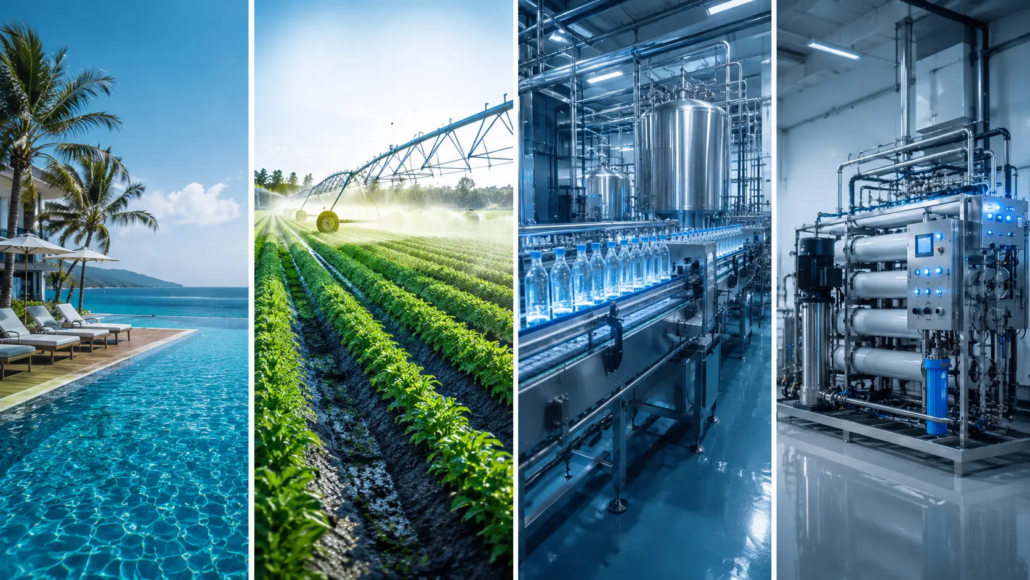
If your facility is dealing with elevated salinity in its water supply, you have likely already confirmed that standard filtration is not solving the problem. The next decision is which salinity reduction system is right for your specific application, your source water profile, and your daily volume requirements. That decision is more nuanced than it might appear, and getting it wrong means investing in a system that either underperforms for your application or exceeds your actual treatment needs at unnecessary cost.
This guide walks through the selection process by industry so you can identify the right system configuration before committing to a specification.
Start Here: What Is Driving Your Salinity Problem?
Before evaluating system options, understanding your salinity source determines your treatment approach. Salinity in commercial and industrial water supplies comes from several distinct origins, each with a different ion profile and concentration range.
Common salinity sources include:
- Brackish groundwater from wells or aquifers with naturally elevated sodium chloride and dissolved mineral content, typically 500 to 12,000 ppm TDS
- Agricultural return water carrying fertilizer salts and irrigation runoff with variable ion profiles
- Coastal aquifer intrusion where proximity to the ocean raises chloride concentrations in freshwater sources
- Municipal supply variation in regions where source water salinity fluctuates seasonally
- Process water recycling where dissolved solids accumulate across production cycles
The TDS concentration and specific ion composition of your source water determine which system type is appropriate. A water quality analysis identifying both TDS and the dominant ion species is the essential starting point before any system selection is made.
Salinity Reduction by Industry
Hotels, Resorts, and Hospitality Facilities
Water quality in hospitality settings affects guest experience directly. Saline water causes scale on fixtures, affects laundry outcomes, degrades pool and spa water chemistry, and can affect the taste of food and beverages prepared on site.
For most resort and hotel applications, source water salinity falls within the brackish range of 500 to 5,000 ppm TDS. A compact, fully automatic brackish water RO system is the standard specification for this application. It requires minimal operator intervention, fits within existing plant room footprints, and produces consistent, low-salinity output across all facility water uses. (Insert internal link to advancees.com/industries/hotels-resorts/)
The ADVANCEES SBWRO Series suits smaller boutique hotels and resorts with moderate daily flow requirements. For larger resort properties with higher daily demand, the MBWRO Series provides greater capacity with the same automatic operation and low maintenance profile.
Key selection factors for hospitality: Compact footprint, low operator input, consistent output quality, remote monitoring capability.
Agricultural Operations
Salinity in agricultural water affects crop yield, soil structure, and irrigation system longevity. Different crops have different salinity tolerance thresholds, and irrigation water that exceeds those thresholds causes progressive yield reduction and long-term soil salinization that compounds across growing seasons.
The correct salinity reduction system for an agricultural operation depends on two variables: the TDS of your irrigation source water and the salinity tolerance of your specific crop or livestock application. Most commercial agricultural operations require irrigation water below 500 to 1,500 ppm TDS depending on crop sensitivity.
For agricultural operations drawing from brackish wells or high-salinity surface sources, a brackish water RO system sized to your daily irrigation volume is the right specification. Solar-powered configurations are particularly well suited to remote or off-grid agricultural sites where grid power is unavailable or expensive to run continuously.
Key selection factors for agriculture: Daily volume capacity, energy source options, source water TDS, crop-specific output quality targets.
Food and Beverage Processing
Water quality in food and beverage production affects product consistency, regulatory compliance, and equipment performance simultaneously. Elevated salinity in process water alters flavour profiles, interferes with fermentation and cooking processes, accelerates corrosion in stainless steel processing equipment, and can create compliance issues under FDA and FSMA standards.
Food and beverage processors typically require process water below 200 to 500 ppm TDS depending on the specific application. Beverage production and brewing operations often have stricter requirements, with some processes demanding water below 50 ppm TDS for flavour consistency.
For food and beverage applications, system selection must account for both salinity reduction and microbial control. A brackish water RO system with UV disinfection post-treatment addresses both requirements within a single treatment train. The MBWRO Series is well suited to mid-sized food and beverage operations where consistent daily output and hygienic design are priorities.
Key selection factors for food and beverage: Output TDS target, microbial compliance requirements, hygienic system design, documentation for regulatory audits.
Light Commercial Facilities
Office buildings, clinics, small manufacturers, and light commercial operations dealing with saline source water typically need a salinity reduction system that is compact, low-maintenance, and reliable without dedicated water treatment staff on site.
For these applications, the SBWRO Series is the standard recommendation. It operates automatically, requires minimal maintenance intervention, and is sized for the moderate daily flow volumes typical of light commercial use.
Key selection factors for light commercial: Compact design, automatic operation, low maintenance requirements, moderate daily output.
The Three Questions That Determine Your System Specification
Regardless of industry, every salinity reduction system selection comes down to three core questions:
1. What is your source water TDS and ion profile?
A full water quality analysis is required before any system is specified. TDS concentration, dominant ion species, hardness, iron content, and biological load all influence which pre-treatment components are needed alongside the core RO membrane system.
2. What is your daily treated water volume requirement?
System capacity must match peak daily demand with adequate margin for seasonal variation and future growth. Undersizing a system creates operational pressure. Oversizing increases capital cost unnecessarily.
3. What is your output quality target?
Different applications require different permeate TDS levels. Knowing your target output quality determines membrane selection, system recovery rate, and whether post-treatment polishing is required.
Work With an Engineer, Not Just a Product Catalogue
The most common mistake in salinity reduction system selection is choosing a system based on price or general specification without a water quality analysis. A system that is correctly specified for your source water and application delivers the expected performance and service life. A system that is not correctly specified will underperform from day one and create ongoing operational problems that cost more to resolve than the engineering advice would have.
ADVANCEES provides design and consultancy support to ensure every system is specified correctly for your water source, your industry application, and your operational requirements.
Contact ADVANCEES today to discuss your salinity reduction requirements and find the right system for your facility.


 ADVANCEES
