
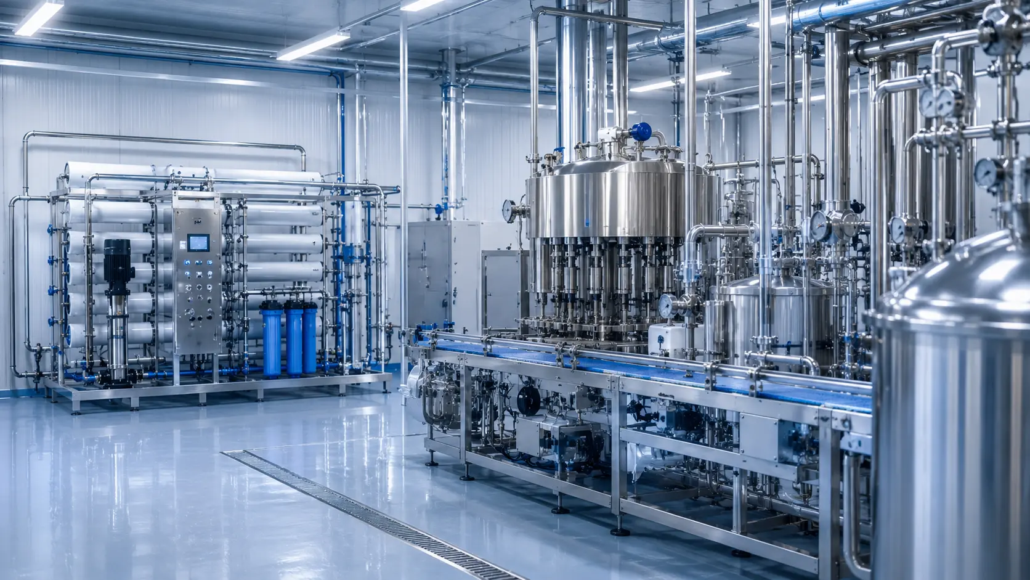
In food and beverage manufacturing, water is not a utility. It is an ingredient, a cleaning medium, a heat transfer fluid, and a regulatory compliance variable all at once. When the salinity of that water exceeds acceptable limits, the consequences do not stay contained to one part of the operation. They spread across product quality, equipment performance, audit outcomes, and in the most serious cases, product recalls and regulatory action.
For quality managers and plant operators dealing with high-salinity source water, the question is rarely whether salinity reduction is necessary. It is whether the current approach is actually solving the problem to the standard that FDA and FSMA requirements demand, or simply managing it well enough to avoid immediate consequences.
What Salinity Does to Food and Beverage Production
Elevated dissolved salts in process water affect food and beverage manufacturing at every stage of production. The impacts are not always visible until they have already created a compliance gap or a product quality failure.
Product Quality and Consistency
Water contacts finished product directly in beverage production, dairy processing, brewing, and cooking operations. Elevated sodium, chloride, and sulfate concentrations alter flavor profiles in ways that are measurable and, in blind taste testing, detectable by consumers. For branded beverage products where consistency is a core quality commitment, batch-to-batch variation driven by source water salinity is an unacceptable variable.
In baking and cooking applications, high-salinity water affects dough development, fermentation rates, and chemical leavening reactions. In dairy processing, mineral content in water used for rinsing and dilution affects protein stability and shelf life outcomes.
Equipment Corrosion and Scale
Stainless steel processing equipment is the industry standard in food and beverage manufacturing for good reason. However, elevated chloride concentrations in high-salinity water accelerate pitting corrosion on stainless steel surfaces, including tanks, pipework, heat exchangers, and filling equipment. That corrosion is not just a maintenance cost. It is a food safety risk if corroded surfaces cannot be adequately cleaned and sanitized to the standard required under FSMA preventive controls.
Scale deposits from calcium and magnesium in hard, saline water build up on heat exchange surfaces, pasteurization equipment, and CIP (clean-in-place) system components. Scale reduces thermal efficiency, creates harbourage points for microbial growth, and increases the chemical load required for effective CIP cycles.
The FDA and FSMA Compliance Dimension
The Food Safety Modernization Act requires food manufacturers to implement science-based preventive controls for all known or reasonably foreseeable hazards, including those introduced through process water. Water quality is explicitly identified as a potential hazard source under FSMA’s Preventive Controls for Human Food rule.
Facilities that use source water with elevated salinity, variable mineral content, or inconsistent TDS without a validated treatment system in place cannot demonstrate adequate preventive control over a known water quality hazard. That gap does not only create risk at the production level. It creates risk during FDA facility inspections, third-party food safety audits, and customer qualification assessments where water quality documentation is a standard review item.
The cost of a water quality-related FDA warning letter, product hold, or voluntary recall significantly exceeds the capital cost of a correctly specified salinity reduction water treatment system. For quality managers building the internal business case for treatment investment, that comparison is the most straightforward financial argument available.
Why Standard Filtration Does Not Meet Food-Grade Requirements
Carbon filtration, sediment filtration, and water softening are common first responses to water quality concerns in food and beverage facilities. Each addresses specific contaminants but none of them reduces salinity or total dissolved solids to the levels required for food-grade process water applications.
Water softeners exchange calcium and magnesium for sodium, which actually increases sodium ion concentration in treated water. For sodium-sensitive product formulations or facilities with sodium limits in their water quality specifications, softening alone moves the problem rather than solving it.
Carbon filtration removes chlorine, chloramines, and some organic compounds. It has no effect on dissolved salt concentration or TDS.
The only technology that reliably reduces salinity in process water to food-grade specifications at a commercial scale is reverse osmosis. A brackish water RO system removes up to 99 percent of dissolved salts, producing permeate water that meets the TDS and ion concentration requirements of even the most sensitive food and beverage applications.
Choosing the Right Salinity Reduction System for Food and Beverage
System selection for food and beverage applications must account for more than TDS reduction. Microbial control, hygienic design, and documentation capability are equally important selection criteria for any facility operating under FSMA preventive controls or third-party food safety certification schemes such as SQF, BRC, or FSSC 22000.
For small to mid-sized food and beverage operations, the ADVANCEES SBWRO Series provides compact, fully automatic salinity reduction with a low maintenance profile suited to facilities without dedicated water treatment staff.
For larger processing facilities with higher daily volume requirements, the MBWRO Series delivers greater capacity with the same automatic operation, real-time performance monitoring, and consistent permeate quality that food-grade applications demand.
Post-treatment UV disinfection is strongly recommended for any food and beverage RO system. RO membranes remove the vast majority of microbial contaminants but do not sterilize permeate water. UV disinfection downstream of the RO unit provides validated microbial reduction without chemical inputs, meeting the hygienic water quality requirements of food contact applications without affecting TDS or ion profile.
Maintenance and Documentation: The Compliance Requirement That Continues After Installation
A salinity reduction system that is not maintained to specification does not maintain compliant output. Membrane performance degrades over time without proper preventive maintenance, and a system producing out-of-specification permeate water that goes undetected creates exactly the kind of undocumented hazard that FSMA preventive controls are designed to prevent.
For food and beverage facilities, an ongoing RO plant service and maintenance program is not optional. It ensures system performance remains within validated parameters, generates the maintenance and water quality records required for regulatory and audit documentation, and identifies membrane replacement or system adjustment requirements before they affect output quality.
ADVANCEES service and maintenance programs are structured to support food and beverage facilities with the documentation trail and performance verification that third-party auditors and FDA inspectors require.
The Cost of Getting It Wrong Is Not a One-Time Event
Salinity-related product quality failures, equipment corrosion, and compliance gaps do not resolve themselves. They compound. A facility that manages salinity reactively through increased chemical use, more frequent equipment maintenance, and inconsistent product quality is paying a recurring operational cost that a correctly specified brackish water RO system eliminates permanently.
Contact ADVANCEES today to discuss your source water conditions, daily volume requirements, and food safety compliance obligations. Our engineering team will specify the right salinity reduction water treatment system for your facility and ensure it is supported with the maintenance and documentation program your operation requires.


 ADVANCEES
