
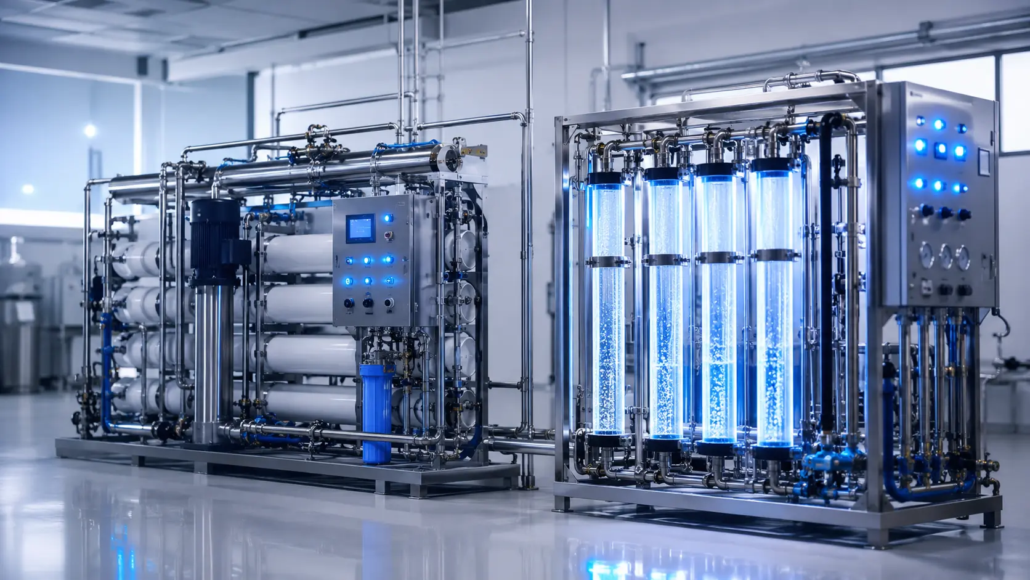
In regulated industries, water purity is not a preference. It is a specification with defined limits, documented verification requirements, and direct compliance consequences when those limits are not met. For pharmaceutical manufacturers, semiconductor fabricators, laboratory operations, and high-purity process industries, achieving ultra-low conductivity water treatment consistently and continuously is a non-negotiable operational requirement.
Two technologies define best practice for this application: reverse osmosis and electrodeionization. Used together as a sequential treatment train, they consistently achieve conductivity output that no single technology or alternative combination can match. This post explains how the combined RO plus EDI system works, when it is required versus standard RO alone, and why it is the correct specification for any facility with strict purity obligations.
What Ultra-Low Conductivity Water Actually Means
Standard commercial and industrial water treatment targets conductivity reduction to below 50 to 500 µS/cm depending on the application. Ultra-low conductivity water occupies a different category entirely.
Regulatory and industry standards for high-purity water applications define conductivity requirements as follows:
- USP Purified Water (pharmaceutical): below 1.3 µS/cm at 25°C
- USP Water for Injection (WFI): below 1.3 µS/cm with additional endotoxin and microbial limits
- ASTM Type I laboratory water: below 0.056 µS/cm (18.2 MΩ·cm resistivity)
- ASTM Type II laboratory water: below 1.0 µS/cm
- Semiconductor ultrapure water: typically below 0.1 µS/cm with sub-ppb dissolved solids
These are not targets that standard reverse osmosis alone reliably achieves. A well-specified brackish water RO system producing permeate at 10 to 50 µS/cm delivers excellent results for most industrial applications. However, for the specifications listed above, further polishing is required. That polishing is where electrodeionization becomes the defining technology.
Why Standard RO Alone Is Not Sufficient for High-Purity Applications
Reverse osmosis membranes reject up to 99 percent of dissolved ions from feed water. However, the remaining one percent matters significantly when your target conductivity is below 1.3 µS/cm. At typical brackish water feed concentrations, even a 99 percent rejection rate leaves residual ion concentrations in the permeate stream that exceed pharmaceutical and laboratory purity specifications.
In addition, carbon dioxide passes through RO membranes freely because it is a dissolved gas rather than an ion in solution. CO₂ dissolves into the permeate water and forms carbonic acid, which dissociates into bicarbonate and hydrogen ions, raising conductivity in the product stream even after high-rejection membrane treatment.
For applications requiring conductivity below 1.3 µS/cm, standard RO permeate requires further treatment. That is precisely the application electrodeionization was developed to address.
How the Combined RO Plus EDI Treatment Train Works
The RO plus EDI treatment train operates as two sequential stages, each performing a distinct function in achieving ultra-low conductivity water treatment.
Stage 1: Reverse Osmosis
Feed water passes through a brackish water RO system, which removes the bulk of dissolved ions, suspended solids, organics, and biological contaminants. Well-designed RO pretreatment upstream of the membrane, including multimedia filtration, softening, and carbon treatment, protects membrane performance and extends service life.
RO permeate typically exits at 10 to 50 µS/cm depending on feed water quality and membrane specification. This permeate then feeds directly into the EDI unit.
Stage 2: Electrodeionization
The EDI unit receives RO permeate and uses a combination of ion exchange resin, semi-permeable membranes, and DC electrical current to remove residual ions continuously. As ions migrate through the resin toward oppositely charged electrodes, the resin regenerates electrochemically without chemical inputs. The result is a continuous, stable output stream at conductivity levels below 0.1 µS/cm.
Critically, EDI also removes dissolved CO₂ and weakly ionized species that pass through RO membranes. This makes the RO plus EDI combination the only treatment train that consistently achieves and maintains conductivity below the thresholds required for USP, ASTM Type I, and semiconductor ultrapure water specifications.
When Ultra-Low Conductivity Treatment Is Required
Not every facility needs conductivity below 1.3 µS/cm. The decision to specify an RO plus EDI system should be driven by your application requirements, not by a general preference for higher purity.
The RO plus EDI treatment train is the correct specification when:
- Your process or product contacts water directly and ionic contamination affects reaction outcomes, product stability, or analytical accuracy
- Regulatory standards define conductivity limits that your verified water quality records must demonstrate compliance with consistently
- Equipment specifications require ultra-low conductivity feed water including high-pressure boilers above 600 psi, analytical instruments, and precision rinsing systems
- Batch-to-batch consistency is a quality requirement and conductivity variability in source water creates unacceptable process variation
Standard RO alone is appropriate when conductivity below 50 µS/cm satisfies your application requirements and no regulatory specification mandates lower limits.
Why This Treatment Train Outperforms All Alternatives
The alternatives to RO plus EDI for ultra-low conductivity water production include chemical deionization, distillation, and nanofiltration plus polishing. Each has meaningful limitations at scale.
Chemical deionization requires acid and caustic regeneration at regular intervals, creating chemical handling costs, compliance obligations, and periodic process interruption. At high throughput volumes, regeneration frequency becomes operationally disruptive and chemically expensive.
Distillation achieves high purity but carries extremely high energy costs, is limited in scalable throughput, and does not address dissolved gases effectively without additional degassing equipment.
The RO plus EDI train eliminates chemical regeneration entirely, operates continuously without batch interruption, scales to meet large daily volume requirements, and consistently achieves conductivity specifications that alternatives cannot match reliably. For pharmaceutical and laboratory operations where water quality documentation is a regulatory obligation, the consistency and auditability of an automated RO plus EDI system is a direct compliance advantage.
Specifying the Right System for Your Purity Requirements
An RO plus EDI system specification depends on your target conductivity, daily flow volume, feed water quality, and application-specific downstream requirements. EDI feed water quality is particularly important. The EDI unit requires RO permeate with hardness below 1 ppm and free chlorine below 0.05 ppm to protect resin and membrane performance. A correctly designed RO pretreatment stage ensures these parameters are met consistently.
ADVANCEES engineers design complete RO plus EDI treatment trains from feed water analysis through to validated permeate output, ensuring every component in the system is correctly specified for your water source and purity target.
Contact ADVANCEES to Discuss Your Ultra-Low Conductivity Requirements
If your facility operates under USP, ASTM, or semiconductor purity specifications, or if your process simply demands the most consistent and verifiable water quality available, the ADVANCEES RO plus EDI treatment train is the right solution.
Contact ADVANCEES today to discuss your conductivity target, daily flow requirement, and feed water conditions. Our engineering team will design the right ultra-low conductivity water treatment system for your application from the ground up.


 ADVANCEES
