
High iron in water is one of the most common water quality problems facing industrial and commercial facilities across the United States. While most people associate iron contamination with rust stains and an unpleasant metallic taste, the consequences for industrial operations go much further.
Equipment fouling, membrane degradation, product contamination, and increased maintenance costs can all result from untreated iron in process water. Understanding how to detect iron, what levels are acceptable, and which industrial treatment systems address the problem is essential for any facility relying on consistent water quality.
How to Detect High Iron in Water
Iron in water appears in two primary forms: ferrous iron (dissolved, often present in clear water) and ferric iron (oxidized, often visible as rust-colored particles). Ferrous iron is more difficult to detect without testing because the water may look clear at the point of collection.
Reliable detection requires laboratory or on-site water analysis. Key indicators of high iron in water include:
- Reddish-brown staining on equipment, pipes, or surfaces
- Metallic taste in process water or finished products
- Clogging or fouling of RO membranes and filtration media
- Increased frequency of filter changeouts
- Discoloration in product batches for food, beverage, or pharmaceutical applications
If your facility draws from a groundwater well, iron testing should be part of your standard water quality protocol. Iron levels in groundwater vary significantly by region. Texas, in particular, has notably high iron concentrations in many aquifers.
Learn more about Texas water iron levels and iron removal solutions.
Safe Iron Limits for Industrial Applications
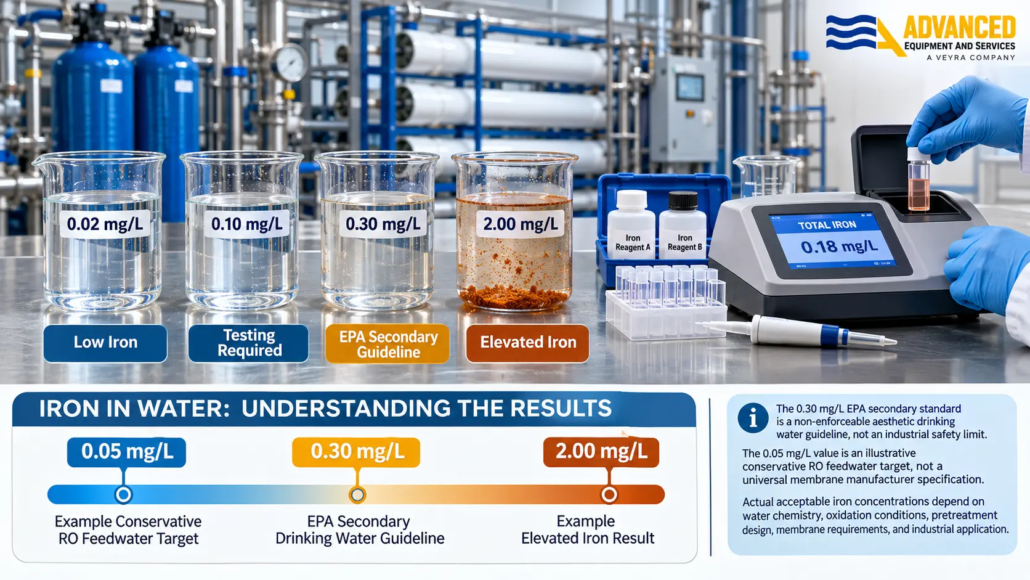
The EPA secondary standard for iron in drinking water is 0.3 milligrams per liter (mg/L). However, this is a non-enforceable aesthetic guideline designed for residential use, not an industrial specification.
Learn more about the legal limits for iron in water and how they relate to water quality.
For industrial applications, acceptable iron levels depend on the process. RO membranes are particularly sensitive. Iron concentrations above 0.05 mg/L can contribute to membrane fouling under certain operating conditions, reducing performance and shortening service life.
Boiler systems, cooling towers, and process water circuits each have their own thresholds. In many cases, industrial facilities should target iron levels well below the residential guideline to protect equipment and maintain operational efficiency.
Why High Iron in Water Damages Industrial Operations
Iron fouling is cumulative. Even at low concentrations, iron oxide can build up on membrane surfaces, heat exchangers, and pipe walls over time.
This accumulation can lead to several operational problems:
- Reduced water flow rates and system efficiency
- Increased energy consumption
- Higher chemical cleaning and maintenance costs
- More frequent membrane and filter replacements
- Premature equipment deterioration or failure
Learn more about the side effects of water with high iron levels and their impact on water treatment systems.
For food and beverage producers, pharmaceutical manufacturers, and electronics facilities, iron contamination creates product quality risks beyond equipment damage. Regulatory compliance and customer specifications may require extremely low or non-detectable iron concentrations.
Industrial Treatment Systems for Iron Removal
Pre-Treatment Filtration
For most industrial facilities, iron removal begins at the pre-treatment stage. Multimedia filtration and iron-specific filter media remove ferric iron particles before water enters downstream systems. This protects RO membranes and other sensitive equipment from fouling.
Explore ADVANCEES industrial water pre-treatment and post-treatment systems for protecting downstream equipment.
Oxidation followed by filtration is a common approach for ferrous iron removal. Aeration or chemical oxidation converts dissolved ferrous iron into ferric iron, which can then be captured by appropriate filtration media.
Reverse Osmosis for Dissolved Iron
When iron concentrations are low or when overall water quality demands a comprehensive treatment approach, reverse osmosis can remove dissolved iron alongside other contaminants.
RO is particularly effective as a polishing step after pre-treatment removes the bulk of the iron load.
Properly designed pre-treatment protects RO membranes from iron fouling and can significantly extend their operational life.
Address Iron Problems Before They Compound
Iron contamination does not resolve itself. Left untreated, it can accumulate in your systems, increase maintenance costs, and create operational risks that become more expensive to address over time.
Contact ADVANCEES today to discuss industrial treatment systems for high iron in water, sized and specified for your facility’s water profile and process requirements.


 ADVANCEES

