
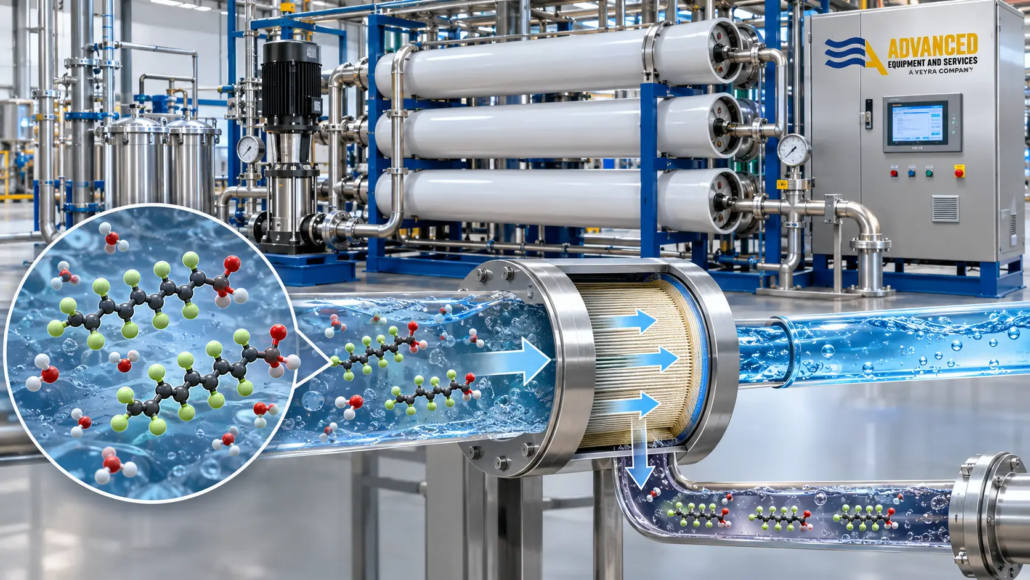
PFAS industrial water treatment is becoming an increasingly important consideration for facilities across the United States. Per- and polyfluoroalkyl substances (PFAS) are a large family of synthetic chemicals known for their persistence in the environment. Many PFAS resist natural degradation and can remain in water and soil for extended periods.
In October 2026, the U.S. Environmental Protection Agency (EPA) announced its first agency-wide PFAS Technology, Evaluation, Coordination, and Harmonization (PFAS TECH) strategy. The initiative emphasizes research, technology evaluation, and practical approaches to PFAS treatment.
For industrial facilities, these developments highlight the importance of understanding potential PFAS contamination, evaluating water treatment options, and identifying applicable regulatory requirements.
What PFAS Are and Why They Matter to Industrial Facilities
PFAS have been used in industrial and consumer products since the 1940s. They are associated with firefighting foams, non-stick coatings, water-resistant textiles, food packaging, and various manufacturing processes.
Because many PFAS are highly persistent, they can enter groundwater and surface water supplies and travel beyond their original sources.
Industrial facilities that rely on affected groundwater, surface water, or municipal supplies may have PFAS in their incoming water without knowing it.
Depending on the application, PFAS contamination can create several concerns:
- Regulatory requirements: Certain facilities may be subject to drinking water, wastewater discharge, remediation, or state-specific requirements.
- Product quality: Sensitive manufacturing processes may require strict control over contaminants in incoming water.
- Water treatment costs: PFAS removal can require specialized equipment, monitoring, and waste management.
- Environmental responsibility: Facilities may need to evaluate how PFAS-containing water and treatment residuals are managed.
- Operational planning: Treatment system upgrades may require additional space, permitting, engineering, and maintenance.
Understanding the source and concentration of PFAS is the first step toward selecting an appropriate industrial water treatment strategy.
The 2024 EPA PFAS Rule and Current Compliance Timeline
In April 2024, the EPA finalized the first federal National Primary Drinking Water Regulation establishing enforceable limits for several PFAS compounds.
The rule established maximum contaminant levels (MCLs) of 4.0 parts per trillion (ppt) for both PFOA and PFOS, two extensively studied PFAS compounds. The original regulation also established requirements for certain additional PFAS and mixtures.
Under the original 2024 rule, regulated public water systems were required to complete initial monitoring by 2027 and implement necessary treatment measures by April 2029.
Proposed EPA Regulatory Changes in 2026
On May 18, 2026, the EPA announced two proposed changes to the federal PFAS drinking water regulations.
- Proposed compliance extension: Eligible public water systems could request an additional two years, extending their PFOA and PFOS compliance deadline to April 2031.
- Proposed rescission: The EPA proposed rescinding regulatory determinations and associated drinking water requirements for PFHxS, PFNA, HFPO-DA (GenX chemicals), and certain PFAS mixtures.
These actions were proposed regulatory changes. They should not be interpreted as finalized amendments unless the EPA completes the applicable rulemaking process.
The EPA’s proposed extension would retain the existing 4.0 ppt drinking water limits for PFOA and PFOS.
Facilities can review the EPA’s proposed PFOA and PFOS compliance extension and the proposed PFAS rescission rule for additional regulatory information.
Do These Requirements Apply to Industrial Facilities?
The federal PFAS drinking water standards apply to regulated public water systems. They do not automatically apply to every industrial facility that uses groundwater or operates a private well.
For facilities purchasing water from a municipal utility, responsibility for meeting federal public drinking water standards generally rests with the regulated water supplier.
Industrial facilities operating their own water supplies may have different obligations depending on whether their systems meet the regulatory definition of a public water system.
Additional requirements may arise from state regulations, wastewater discharge permits, environmental remediation obligations, or industry-specific water quality specifications.
Industrial facilities should evaluate their individual regulatory requirements rather than assuming that one federal drinking water deadline applies to every operation.
EPA’s October 2026 PFAS TECH Strategy
On October 26, 2026, the EPA announced its first agency-wide PFAS Technology, Evaluation, Coordination, and Harmonization (PFAS TECH) strategy.
The initiative focuses on advancing PFAS treatment technologies and supporting practical solutions through research, pilot projects, technical assistance, and partnerships.
Key priorities include:
- Supporting research into emerging PFAS treatment and destruction technologies
- Evaluating treatment performance through pilot-scale projects
- Encouraging collaboration between government agencies, researchers, and private industry
- Improving access to technical guidance and treatment information
- Exploring scalable approaches to PFAS removal and management
The PFAS TECH strategy does not establish new drinking water limits or automatically change existing compliance deadlines. Instead, it supports the development and evaluation of technologies that may help address PFAS contamination.
Read the EPA’s official PFAS TECH announcement for additional information.
How Industrial Facilities Should Assess Their PFAS Risk
The first step in evaluating PFAS contamination is a comprehensive water quality assessment.
PFAS cannot be reliably identified through appearance, taste, or odor. Specialized laboratory testing is required to determine which compounds are present and their concentrations.
PFAS Testing Methods
EPA Methods 533 and 537.1 are established analytical methods for measuring certain PFAS in drinking water.
For industrial wastewater and other environmental samples, different analytical methods may be appropriate, including EPA Method 1633A.
Facilities should work with a qualified laboratory to select a testing method appropriate for their water source, regulatory requirements, and treatment objectives.
A baseline PFAS assessment should identify:
- Which PFAS compounds are present in the water
- The concentration of each detected compound
- The source and intended use of the water
- Applicable water quality standards or process requirements
- Required treatment capacity and daily flow rates
- Potential treatment residuals and disposal considerations
Facilities located near airports, military installations, landfills, industrial manufacturing sites, or other areas with documented PFAS contamination may benefit from prioritizing water quality testing.
Once laboratory results are available, engineers can evaluate the most appropriate treatment technologies for the facility.
Industrial PFAS Water Treatment Technologies
Several established water treatment technologies can reduce PFAS concentrations. The most appropriate solution depends on the specific PFAS compounds, water chemistry, treatment objectives, and operational requirements.
Granular Activated Carbon (GAC)
Granular activated carbon removes certain PFAS compounds through adsorption. As contaminated water passes through the carbon media, PFAS molecules attach to the carbon surface.
GAC is an established treatment option, particularly for certain longer-chain PFAS compounds.
However, removal performance varies by compound and water quality. Carbon media eventually reaches its treatment capacity and requires replacement or appropriate management.
Ion Exchange Resins
Specialized ion exchange resins can capture PFAS compounds from contaminated water.
These systems can provide effective treatment in suitable applications, although resin selection, competing contaminants, and operating conditions influence performance.
Spent resin must also be managed appropriately because the captured PFAS remain associated with the treatment media.
Reverse Osmosis for PFAS Removal
Reverse osmosis (RO) is an established membrane treatment technology capable of reducing many PFAS compounds in contaminated water.
RO systems use pressure to move water through semipermeable membranes. The membranes reject many dissolved contaminants, including numerous PFAS compounds, while producing a purified water stream known as permeate.
Properly designed RO systems can achieve high PFAS removal efficiencies. However, actual performance depends on several factors:
- Types and concentrations of PFAS present
- Membrane selection and operating pressure
- Feedwater chemistry and competing contaminants
- System configuration and recovery rate
- Membrane condition and ongoing maintenance
Facilities should not assume that a specific removal percentage is guaranteed without appropriate engineering evaluation and performance testing.
PFAS Removal vs. PFAS Destruction
Reverse osmosis removes PFAS from the treated water but does not destroy them.
During treatment, rejected PFAS become concentrated in the RO reject stream, also called concentrate or brine.
This concentrated waste stream requires appropriate management under applicable environmental and disposal requirements.
Potential management approaches depend on the facility’s permits, waste characteristics, available treatment infrastructure, and regulatory obligations.
Therefore, a complete PFAS treatment strategy must address both the quality of the treated water and the management of PFAS-containing residuals.
Containerized Reverse Osmosis Systems for Industrial PFAS Treatment
For facilities requiring flexible treatment infrastructure, containerized reverse osmosis systems may provide a practical solution.
These systems integrate water treatment equipment into a modular enclosure that can be configured for different treatment capacities and site requirements.
Potential benefits include:
- Modular design: Treatment equipment can be configured around specific flow requirements.
- Flexible installation: Containerized equipment can reduce the need for dedicated treatment buildings in suitable applications.
- Scalability: Additional treatment capacity may be incorporated as operational requirements change.
- Centralized equipment: Pumps, membranes, instrumentation, and controls can be integrated into a coordinated system.
- Industrial applications: Systems can be engineered for continuous water treatment where appropriate.
Containerized RO systems are not automatically suitable for every PFAS application. Treatment feasibility depends on the water quality profile, required removal performance, pretreatment needs, and concentrate management strategy.
ADVANCEES also offers the ARKQUA Series reverse osmosis systems for applicable water treatment projects. Equipment selection should be based on the specific feedwater conditions and required treatment performance rather than assuming that a particular product series is designed specifically for PFAS removal.
Start Planning Your Industrial PFAS Water Treatment Strategy
PFAS contamination presents technical, environmental, and operational challenges for industrial facilities.
Although regulatory requirements differ by application, early water quality assessment provides valuable information for future treatment decisions.
Developing an effective PFAS water treatment strategy typically involves:
- Testing incoming water for relevant PFAS compounds
- Reviewing applicable federal, state, and local requirements
- Identifying treatment performance objectives
- Comparing available water treatment technologies
- Evaluating equipment capacity and operating costs
- Planning for PFAS concentrate or spent media management
- Designing a suitable monitoring and maintenance program
ADVANCEES provides RO plant design and consultancy services to help industrial facilities evaluate water treatment technologies and system configurations.
Our team can assist with assessing treatment requirements, selecting appropriate reverse osmosis equipment, and developing solutions based on your facility’s water quality and operational needs.
Contact ADVANCEES today to discuss PFAS industrial water treatment options and explore a system configuration suited to your facility.
Regulatory note: Federal and state PFAS requirements may change. The regulatory information in this article reflects EPA materials reviewed in November 2026. Facilities should confirm current requirements with the appropriate regulatory authority before making compliance decisions.


 ADVANCEES

