
When a hurricane makes landfall, a flood overwhelms a water treatment plant, or an earthquake ruptures distribution infrastructure, municipal water utility managers and county emergency directors face a problem that cannot wait for a standard procurement cycle. Their community needs clean water now, their existing supply is compromised or destroyed, and the budget, approval, and logistics processes they normally operate within were not designed for a 48-hour decision timeline.
For small towns and municipalities in coastal, flood-prone, or disaster-vulnerable regions, understanding how to access an emergency desalination system quickly and affordably before a crisis occurs is one of the most important pieces of emergency preparedness planning a water utility director can do.
This post covers:
- Emergency procurement pathways
- The leasing versus purchasing decision
- How to match system capacity to community size
- Why containerized, in-stock systems are the fastest route to restoring clean water
The Municipal Emergency Water Problem Is Different from the Commercial One
Private facility operators dealing with a water supply emergency have a relatively straightforward decision pathway. They identify the problem, contact a supplier, and procure a solution within their existing operational budget authority.
Municipal procurement does not work that way. Water utility managers and county emergency directors typically operate within procurement frameworks that may require:
- Competitive bidding
- Council or board approval
- State or federal contracting compliance
- Budget authorization
Under normal circumstances, these processes can take weeks or months to complete.
A major storm or infrastructure failure compresses that timeline to hours. Communities that have not pre-identified their emergency water treatment options, established supplier relationships, and understood their emergency procurement authority before a crisis occurs may spend the first critical days navigating administrative processes instead of deploying treatment capacity.
The solution is not to bypass procurement governance. It is to complete the preparedness work in advance so that when emergency authority is invoked, the decision about which system to deploy and how to access it has already been made.
Procurement Pathways for Municipal Emergency Desalination Systems
Municipal water utilities and county emergency management offices may have several procurement pathways available for emergency water treatment systems that can shorten the normal acquisition timeline.
Emergency Declaration Procurement
When a state of emergency is declared at the local, state, or federal level, emergency procurement authority may be granted to designated officials. Under emergency procurement rules, direct contracting with a pre-qualified supplier may be permissible depending on the jurisdiction and applicable procurement requirements.
Having ADVANCEES pre-qualified as a supplier within your jurisdiction before an emergency occurs can remove a critical step from the procurement timeline when emergency authority is activated.
FEMA Public Assistance and Hazard Mitigation Programs
FEMA’s Public Assistance program may provide reimbursement for eligible emergency protective measures taken by state and local governments in response to declared disasters, including certain emergency water treatment costs.
Understanding potential reimbursement pathways before a disaster occurs allows water utility managers to make deployment decisions with a clearer understanding of how emergency costs may be funded or recovered.
Pre-Positioned Leasing Agreements
For municipalities that cannot commit to capital procurement, a pre-negotiated leasing agreement can provide a practical emergency preparedness option.
Rather than purchasing a system that may remain unused during non-emergency periods, a pre-negotiated lease can allow the municipality to access an in-stock ADVANCEES ARKQUA system when needed, under financial and operational terms established in advance.
Learn more about ADVANCEES leased water treatment solutions.
Leasing Versus Purchasing for Municipal Emergency Use
The lease versus purchase decision for emergency water treatment is typically driven by three primary factors:
- Available capital and operating budget
- Expected frequency of use
- Anticipated deployment duration
When Leasing Makes More Sense
For many small towns and municipalities, leasing can be the more practical option for emergency water treatment. Capital budgets for water utilities are often committed years in advance through infrastructure planning cycles. Allocating capital for an emergency desalination system that may not be used every year can compete directly with already approved maintenance and upgrade projects.
A leasing arrangement can provide several advantages:
- Converts a large capital purchase into a predictable operating expense
- Reduces the upfront financial barrier to emergency preparedness
- Can align more easily with emergency reserve funding or reimbursement programs
- Reduces municipal storage and long-term maintenance requirements
- Provides access to equipment that remains maintained and ready for deployment
Monthly lease costs are also easier to document and review during post-disaster financial audits.
When Purchasing Makes More Sense
For municipalities in high-risk regions that expect to deploy an emergency water treatment system repeatedly over a ten to fifteen year period, outright purchase may provide a lower total cost over the life of the equipment.
Examples may include:
- Coastal communities with recurring hurricane exposure
- Municipalities with aging water infrastructure
- Regions that regularly experience flooding or saltwater intrusion
- Communities that require recurring backup treatment capacity
These municipalities should compare the total cost of ownership with cumulative lease costs based on realistic deployment frequency.
ADVANCEES can provide cost modeling support based on a municipality’s specific risk profile and expected use.
Matching System Capacity to Community Size
One of the most common mistakes in municipal emergency water treatment procurement is selecting a system based on what is available instead of what the community actually requires.
An undersized system leaves part of the population without adequate supply. An oversized system increases cost and logistical complexity without necessarily improving the response.
Daily output requirements should account for factors such as:
- Population served
- Minimum drinking and cooking requirements
- Sanitation and hygiene demand
- Healthcare or emergency shelter requirements
- Expected duration of the outage
For emergency response, a minimum of 15 liters per person per day may cover basic drinking and cooking needs. For a more comprehensive emergency supply that includes sanitation and hygiene, approximately 35 to 50 liters per person per day may be required.
The ADVANCEES ARKQUA range is available across multiple output capacities, allowing water utility managers to specify a system that more closely matches the community’s population and daily water demand.
Explore ADVANCEES containerized RO systems.
For communities where the output of a single unit is not sufficient, multiple ARKQUA systems can be deployed in parallel at a central distribution point without requiring extensive permanent infrastructure.
For additional background, see ADVANCEES’ resource on containerized seawater solutions for municipalities and small towns.
Fast Deployment When the Community Cannot Wait
Once a municipality activates emergency procurement authority and commits to deploying a water treatment system, the next question is how quickly the system can become operational.
For communities where municipal supply has been fully interrupted, every additional day without clean water creates greater public health and logistical challenges.
ADVANCEES ARKQUA reverse osmosis and desalination systems are available in stock for immediate dispatch. Learn more about ARKQUA 200 and ARKQUA 500 rental and leasing options.
For municipal emergency managers who have pre-identified ARKQUA as their emergency deployment solution and established access terms in advance, the timeline from activation to treated water production can be significantly shorter than a traditional procurement process.
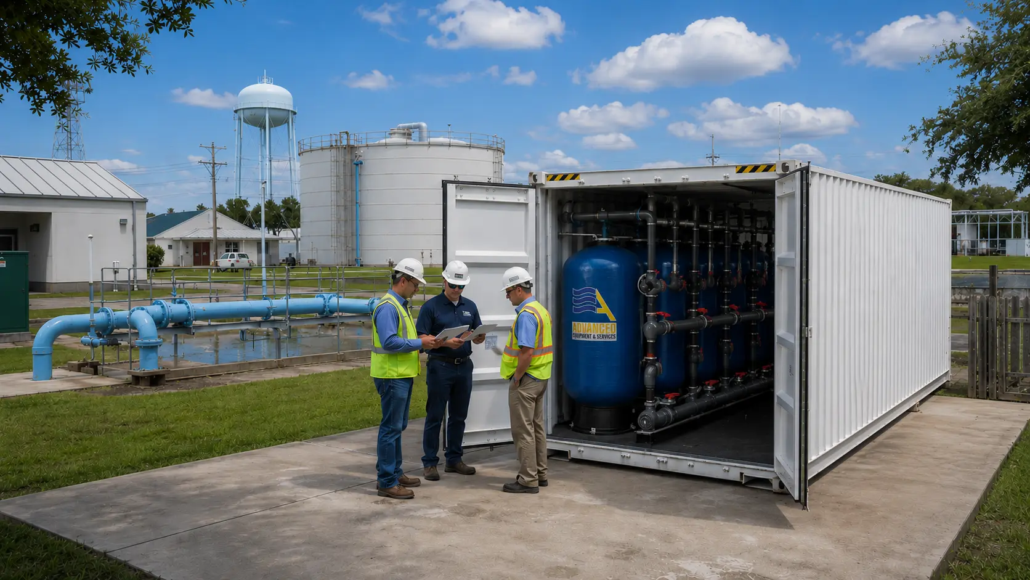
Each ARKQUA unit is containerized and designed for rapid field deployment. Key advantages include:
- No major civil works
- No extensive on-site assembly
- Self-contained equipment configuration
- Connection to available feed water and power
- Technical support from ADVANCEES during commissioning
Municipal maintenance personnel with basic mechanical competency can complete key site connections with guidance from ADVANCEES technical support, either on site or remotely.
Start the Preparedness Conversation Before the Storm Season Peaks
The worst time for a municipality to begin evaluating emergency water treatment options is during an active emergency. Suppliers may be handling multiple simultaneous requests, logistics networks may already be constrained, and administrative steps that could have been completed during preparedness planning must now be addressed under crisis conditions.
The better approach is to prepare before the next major event.
Municipalities should consider completing the following before emergency conditions develop:
- Identify potential source-water options
- Estimate emergency daily water demand
- Determine the appropriate ARKQUA capacity
- Review leasing versus purchasing options
- Understand local emergency procurement authority
- Pre-qualify suppliers where appropriate
- Confirm deployment and power requirements
Contact ADVANCEES today to discuss ARKQUA system options for your municipality, explore leasing and pre-negotiated access arrangements, and confirm current stock availability across capacity options that fit your community’s population and daily water demand.


 ADVANCEES
