
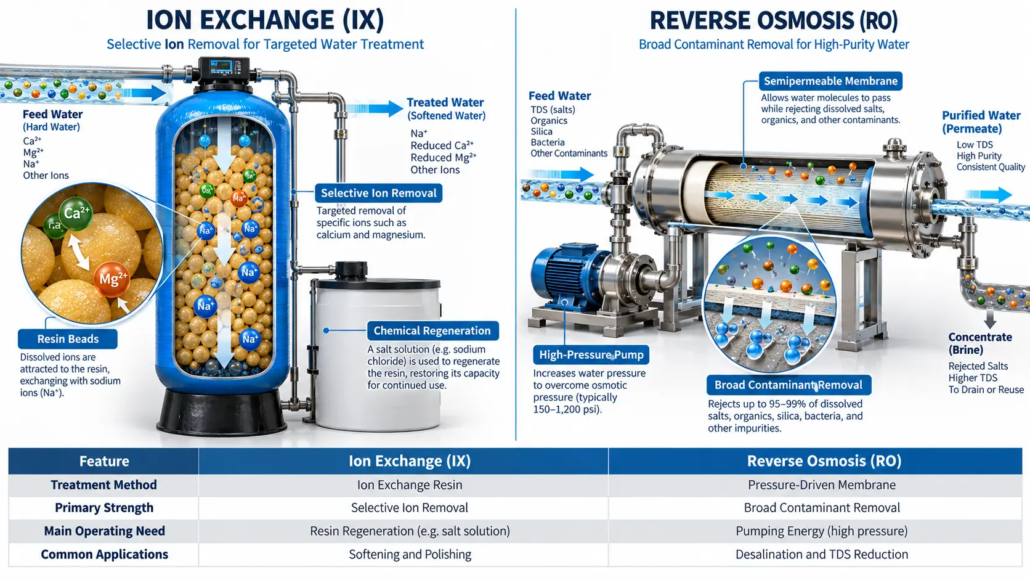
When evaluating ion exchange water treatment against reverse osmosis, industrial buyers face a decision that directly affects operating costs, water quality, and long-term system reliability. Both technologies remove dissolved contaminants from water. However, they work differently, suit different applications, and carry different cost profiles over time. Understanding the distinction helps you choose the right system for your facility.
How Ion Exchange Water Treatment Works
Ion exchange is a chemical process that removes dissolved ions from water by swapping them with ions held on a resin bed. As water passes through the resin, unwanted ions such as calcium, magnesium, sodium, and heavy metals attach to the resin while acceptable ions release into the water stream.
Over time, the resin becomes saturated and requires regeneration using either acid or caustic chemicals, depending on whether the resin targets positively or negatively charged ions. Ion exchange systems can achieve very high purity levels, particularly for specific target contaminants, but the regeneration process adds chemical handling, waste disposal, and operational complexity.
Ion exchange is widely used for water softening, selective heavy metal removal, and as a final polishing step in ultrapure water production. Learn more about ADVANCEES ion exchange water treatment solutions.
How Reverse Osmosis Works
Reverse osmosis forces water through a semi-permeable membrane under pressure. The membrane rejects dissolved solids, ions, bacteria, and organic compounds, producing purified permeate and a concentrated brine stream as a byproduct.
RO systems address a broad range of contaminants simultaneously. A single RO pass typically removes 95 to 99 percent of dissolved solids, making it one of the most efficient and versatile treatment technologies available for industrial applications.
Unlike ion exchange, reverse osmosis does not require chemical regeneration. The primary inputs are energy for pressure and periodic membrane cleaning. For high-volume industrial operations, this significantly reduces ongoing operating costs and chemical management requirements.
Explore ADVANCEES brackish water reverse osmosis systems for commercial and industrial applications.
Ion Exchange vs. Reverse Osmosis: Key Differences
Although both technologies are effective for industrial water treatment, several important differences influence which solution is best suited for a facility.
Contaminant Range
Reverse osmosis addresses a wider range of contaminants in a single pass. Ion exchange is highly effective for specific ions but generally does not remove non-ionic contaminants such as organics, bacteria, or silica in the same way RO does.
For facilities dealing with high TDS water, brackish water, or broad-spectrum contamination, RO provides more comprehensive treatment with less process complexity.
Operating Costs
Ion exchange systems have lower capital costs at smaller scales. However, ongoing costs for resin regeneration chemicals, waste neutralization, and labor add up significantly over time. For high-volume applications, these costs can exceed the operational savings from lower initial investment.
RO systems carry higher upfront equipment costs but lower ongoing chemical costs. At industrial scale, the total cost of ownership over a 5 to 10 year horizon typically favors reverse osmosis for continuous, high-volume treatment.
Water Quality Targets
Both technologies can achieve high purity levels. However, when ultra-low conductivity water is required, such as for pharmaceutical manufacturing, semiconductor fabrication, or high-pressure boiler feed, the most effective approach combines RO with electrodeionization (EDI).
EDI replaces the chemical regeneration step of traditional ion exchange with a continuous electrochemical process. The result is consistent ultrapure water output without the chemical handling and waste disposal of conventional ion exchange systems.
Learn more about ADVANCEES electrodeionization systems for high-purity industrial water applications.
Footprint and Scalability
RO systems scale efficiently for larger flow rates. Ion exchange systems become increasingly complex and costly to scale, as larger resin volumes require proportionally more chemical regeneration capacity and more frequent service cycles.
For facilities planning future expansion, RO-based systems offer a more straightforward path to increased capacity.
Which Technology Is Right for Your Application?
Ion exchange remains a strong choice for targeted applications, small-scale softening, and as a final polishing stage in a broader treatment train. It is not well-suited as a standalone solution for high-volume industrial water treatment with broad contamination.
Reverse osmosis is the preferred choice for:
- High TDS or brackish source water
- Continuous, high-volume production environments
- Applications requiring broad-spectrum contaminant removal
- Facilities seeking to minimize chemical handling and waste
- Systems where RO plus EDI achieves ultrapure water targets
In many industrial facilities, the most effective answer is not one technology or the other. It is a properly engineered combination of both, with RO handling the bulk of treatment and ion exchange or EDI handling final polishing.
Contact ADVANCEES today to discuss which water treatment configuration is right for your application and flow requirements. Our RO plant design and consultancy services can help you identify the appropriate treatment technologies for your facility.


 ADVANCEES
