
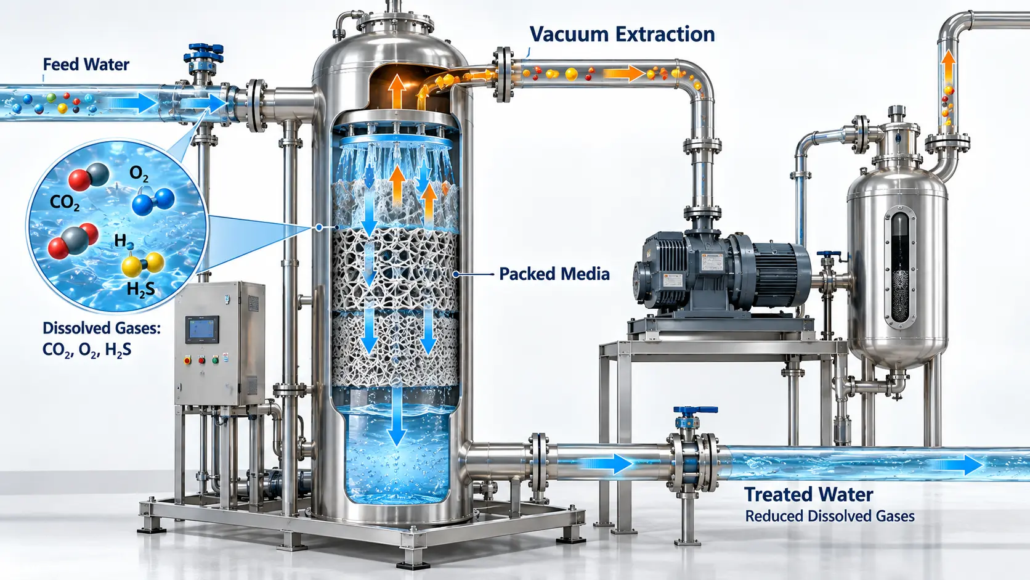
If your facility runs a reverse osmosis system, a boiler feed line, or any process that depends on consistent water chemistry, dissolved gases are a problem you may already have without knowing it. A degassing system for industrial water treatment removes gases such as carbon dioxide, hydrogen sulfide, and oxygen from process water before they cause corrosion, scaling, membrane fouling, or product contamination. Understanding when your application requires one can prevent significant equipment damage and operational downtime.
What a Degassing System Does
Dissolved gases enter water from multiple sources, including:
- Source water containing naturally occurring dissolved gases
- Atmospheric exposure
- Biological activity
- Chemical reactions within the treatment process
Once in the water, these gases create problems that standard filtration and RO membranes cannot fully resolve on their own.
A degassing system removes dissolved gases by exposing water to a low-pressure environment, a stripping gas, or a membrane degassing module that allows gas molecules to pass through while retaining the liquid. The result is water with dramatically reduced dissolved gas concentrations, which protects downstream equipment and improves process stability.
The two most common gases targeted in industrial water treatment are carbon dioxide and oxygen. However, hydrogen sulfide removal is also a critical application in oil and gas, groundwater treatment, and certain municipal systems.
Learn more about how industrial water degassing systems work and their applications.
Why Dissolved Gases Cause Problems in Industrial Systems
Carbon Dioxide and Carbonate Scaling
Carbon dioxide dissolved in water lowers pH and affects carbonate chemistry, which can contribute to calcium carbonate scaling under certain treatment conditions. In RO systems, carbonate scaling is one of the leading causes of membrane fouling and premature membrane replacement. Removing CO2 at an appropriate stage in the treatment process can help stabilize pH and manage downstream scaling potential.
In addition, high CO2 levels reduce the efficiency of downstream ion exchange and EDI systems by increasing the ionic load associated with dissolved carbon dioxide. A degassing step placed between the RO unit and the EDI system can reduce this load and improve overall system performance.
Learn more about water degasification and reverse osmosis.
Oxygen and Corrosion
Dissolved oxygen is a major driver of corrosion in boiler feed water systems, cooling water loops, and metal pipework. Even small concentrations at the parts-per-billion level can cause accelerated oxidation in high-temperature, high-pressure environments.
Power plants, steam generators, and industrial boilers require deaerated feed water to protect heat exchange surfaces and pressure vessels. Mechanical deaeration and membrane degassing are both established methods for achieving the low dissolved oxygen levels these systems demand.
Hydrogen Sulfide and Process Contamination
Hydrogen sulfide produces the characteristic rotten egg odor associated with groundwater sources and certain industrial wastewater streams. Beyond odor, H2S is corrosive to copper alloys and can interfere with processes in food and beverage, pharmaceutical, and electronics manufacturing.
Degassing systems designed specifically for H2S removal use forced draft or vacuum stripping to drive the gas out of solution before it reaches sensitive process equipment or product contact surfaces.
Applications That Commonly Require Degassing
Industrial facilities that most frequently need dedicated degassing systems include:
- Boiler Feed Water Systems: Dissolved oxygen must be reduced to prevent corrosion in pressure vessels and heat exchangers.
- Reverse Osmosis Pretreatment or Post-Treatment: CO2 removal helps stabilize pH and protects EDI and ion exchange polishing stages.
- Pharmaceutical and Laboratory Water Systems: Dissolved gases can interfere with analytical accuracy or sensitive manufacturing processes.
- Food and Beverage Production: Dissolved oxygen accelerates oxidation and can affect product shelf life and flavor.
- Groundwater Treatment: Naturally occurring H2S or CO2 may require removal before water enters the main treatment train.
- Cooling Tower Makeup Water: Gas removal can help reduce corrosion risks in recirculating systems.
Explore ADVANCEES pre-treatment and post-treatment systems for industrial water applications.
How to Determine If Your Facility Needs a Degassing System
The decision to add a degassing system typically comes from one of three situations:
- Corrosion or Scaling: Visible deterioration or mineral buildup in downstream equipment.
- pH Instability: Inconsistent treated water pH despite chemical dosing or other treatment adjustments.
- Water Quality Requirements: Industrial processes that specify maximum dissolved gas concentrations.
If your RO membranes are fouling faster than expected, if your boiler feed water is failing conductivity or oxygen targets, or if your treated water pH is inconsistent despite chemical dosing, dissolved gases may be contributing to the problem.
A proper system assessment starts with water quality testing for CO2, dissolved oxygen, and H2S, followed by a review of your downstream process requirements.
The appropriate degassing configuration depends on several factors:
- Types and concentrations of dissolved gases present
- Required outlet gas concentrations
- Water flow rate and daily treatment capacity
- Downstream equipment and water quality requirements
- Selection of membrane contactors, packed tower strippers, or vacuum degassers
Contact ADVANCEES today to evaluate whether a degassing system belongs in your water treatment process. Our RO plant design and consultancy services can help determine the appropriate treatment configuration for your facility.


 ADVANCEES