
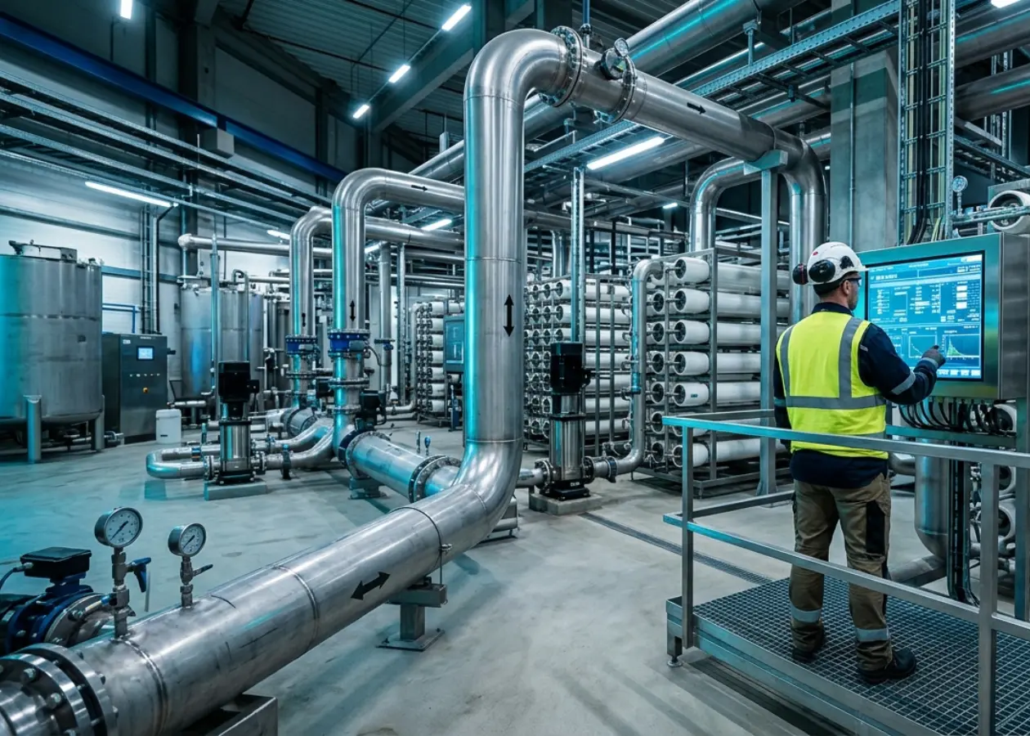
If your facility relies on groundwater, municipal supply, or surface water sources, high TDS water treatment is likely already a concern, even if you have not identified it yet. Total dissolved solids are one of the most common and most damaging water quality problems facing commercial and industrial operations today. Understanding what TDS is, where it comes from, and what it does to your facility is the first step toward protecting your equipment, your output, and your bottom line.
What Is TDS and Where Does It Come From?
TDS stands for total dissolved solids. It refers to the combined concentration of all inorganic and organic substances dissolved in water, including salts, minerals, metals, and ions. TDS is measured in parts per million (ppm) or milligrams per liter (mg/L), and it is one of the most reliable indicators of overall water quality.
Common sources of elevated TDS in commercial and industrial water supplies include:
- Natural mineral deposits in groundwater aquifers
- Agricultural runoff carrying fertilizers and pesticides
- Industrial discharge entering surface water sources
- Aging municipal distribution infrastructure leaching metals
- Saltwater intrusion into coastal or low-lying aquifers
- Seasonal flooding that introduces surface contaminants into supply lines
In many parts of the United States, source water naturally carries TDS levels that exceed safe thresholds for commercial use, particularly in the Southwest, Gulf Coast, and inland agricultural regions where groundwater salinity is high.
What Are Acceptable TDS Levels for Commercial and Industrial Use?
Not all applications tolerate the same TDS concentration. Understanding the thresholds relevant to your operation determines whether you have a problem and how urgent it is.
Drinking and Food-Grade Water
The EPA recommends a maximum TDS of 500 ppm for drinking water. Food and beverage processors typically require levels well below this threshold to protect product quality and meet regulatory standards.
Boiler Feed Water
Boiler systems are among the most TDS-sensitive applications in any industrial facility. Depending on boiler pressure and design, acceptable TDS in feed water can range from as low as 50 ppm to 500 ppm. Exceeding these levels accelerates scale formation, reduces heat transfer efficiency, and shortens equipment life significantly.
Cooling Towers
Cooling tower systems generally tolerate TDS up to 1,000 ppm before scaling and corrosion become serious operational concerns. However, as TDS climbs above that threshold, maintenance costs and equipment downtime increase rapidly.
General Process Water
Manufacturing, chemical processing, and light industrial applications vary widely, but most process water applications perform best below 500 ppm. Above 1,000 ppm, dissolved solids begin to interfere with chemical reactions, product consistency, and equipment performance.
When Does High TDS Become a Serious Operational Problem?
High TDS water causes damage quietly and consistently. By the time most facility managers recognize the symptoms, the cost of inaction has already accumulated.
The operational consequences of untreated high TDS water include:
- Scale buildup on heat exchangers, pipes, and membrane surfaces that reduces efficiency and increases energy consumption
- Corrosion of metal components caused by elevated chloride and sulfate concentrations
- Membrane fouling in existing filtration systems that shortens service life and increases replacement costs
- Product quality failures in food, beverage, and pharmaceutical applications where water purity directly affects output
- Increased chemical treatment spend as facilities attempt to manage symptoms rather than address the source
In addition, high TDS water that exceeds discharge regulations can expose facilities to EPA and state-level compliance penalties, particularly in sectors with strict effluent standards.
High TDS Water Treatment: Why Reverse Osmosis Is the Right Solution
Standard filtration, softeners, and chemical dosing can manage some aspects of water quality but none of them reduce TDS effectively at a commercial scale. Reverse osmosis is the only widely proven technology that removes dissolved solids across the full range of commercial and industrial TDS concentrations.
For facilities dealing with source water between 500 and 12,000 ppm TDS, a brackish water reverse osmosis system is the purpose-built solution. The ADVANCEES SBWRO Series handles light commercial and industrial applications with a compact, fully automatic design. For larger daily flow requirements, the MBWRO Series and LBWRO Series scale to meet the demands of mid-size and large industrial operations.
Every system in the ADVANCEES brackish water range is engineered to treat high TDS source water consistently, with automatic controls, remote monitoring capability, and pre-treatment options tailored to your specific water chemistry.
Start With a Water Quality Assessment
If you are unsure whether high TDS is affecting your facility, the starting point is a water quality test. TDS can be measured on-site with a basic meter, but a full water analysis will identify the specific dissolved solids present and guide the right treatment approach.
Contact ADVANCEES today to discuss your source water conditions and find the right high TDS water treatment system for your facility. Our engineering team provides design and consultancy support to ensure your system is correctly specified from day one.


 ADVANCEES
