
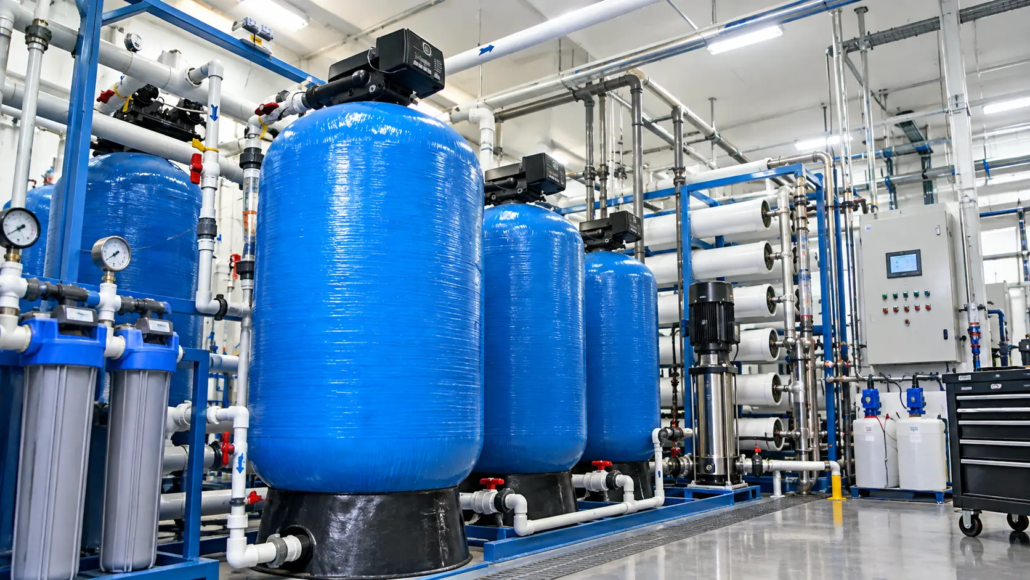
Water filtration maintenance is one of the most common areas where industrial facilities underinvest, until a system failure forces the conversation. Most operations managers know their RO system needs servicing. Far fewer have a structured, interval-based maintenance schedule in place that actually matches the demands of industrial-scale operation.
The consequence of that gap is predictable. Membranes foul ahead of schedule. Pre-treatment components degrade undetected. Pressure differentials climb until permeate flow drops below production requirements. What could have been resolved with a scheduled cleaning or a filter cartridge replacement becomes an unplanned shutdown during a production run.
This post sets out a practical water filtration maintenance schedule for industrial RO systems, built around real service intervals, what to inspect at each stage, and why each task matters operationally.
Why Industrial RO Maintenance Is Different from Commercial Maintenance
An industrial reverse osmosis system operates under conditions that a light commercial unit never faces. Higher daily throughput, more demanding feed water profiles, continuous around-the-clock operation, and tighter output quality requirements all create a maintenance environment where the consequences of missed service intervals are significantly more serious.
Industrial RO systems may have to contend with:
- Higher daily water throughput
- Continuous or around-the-clock operation
- Elevated TDS, hardness, or biological load
- Higher system recovery rates
- Stricter permeate quality requirements
A commercial RO system serving a small facility can tolerate a degree of flexibility in its maintenance schedule without immediate operational consequences. An industrial system running 24 hours a day at high recovery rates, treating feed water with elevated TDS, hardness, or biological load, cannot.
Every missed service interval compounds into measurable performance degradation that shows up in permeate quality, energy consumption, and membrane service life.
The maintenance schedule below is structured for industrial-scale operation. Adapt intervals based on your specific feed water quality, daily run hours, and system recovery rate.
Monthly Water Filtration Maintenance Tasks
Monthly checks are the foundation of effective industrial RO maintenance. They take less than an hour and catch the early warning signs that prevent expensive failures later.
Performance Logging
Record and compare the following measurements against your commissioning baseline and the previous month’s log:
- Feed pressure
- Permeate pressure
- Concentrate pressure
- Permeate flow
- Permeate TDS or conductivity
Normalized data trending is the most reliable early indicator of membrane fouling or scaling before it becomes a performance problem.
Pre-Filter Cartridge Inspection
Check differential pressure across pre-filter housings. Replace cartridges when differential pressure reaches 10 to 15 psi above the clean baseline.
Running over-pressure cartridges forces unfiltered particulates toward the membranes and shortens membrane life directly.
Chemical Dosing Systems
Verify antiscalant and biocide dosing rates and chemical tank levels. Antiscalant underdosing is one of the leading causes of premature scaling on industrial RO membranes, particularly in hard or high-sulfate feed water.
Visual Inspection
During each monthly inspection:
- Check visible connections and fittings for leaks.
- Inspect pressure vessels for visible problems.
- Review the control panel for alarm history.
- Check for operational flags that may indicate intermittent performance issues between logged inspections.
Quarterly Service Tasks
Quarterly service goes deeper into system components that monthly checks monitor but do not fully service.
Multimedia Filter Backwash Verification
Confirm that automated backwash cycles are completing on schedule and that backwash flow rates are adequate to fluidize and clean the filter bed.
A multimedia filter running with degraded backwash performance passes increasing turbidity and particulate load to downstream membranes.
Learn more about ADVANCEES multimedia filtration systems.
Water Softener Performance Check
Test hardness in the softener outlet to confirm resin is regenerating effectively and removing calcium and magnesium to the required level.
Hardness breakthrough into the RO feed stream causes rapid scaling on membrane surfaces that antiscalant alone cannot prevent at high hardness concentrations.
Learn more about ADVANCEES FRP water softeners.
Pump Performance Verification
Compare high-pressure pump flow and pressure output against commissioning specifications. Pump wear shows gradually in performance data before it causes a system fault.
Identifying declining pump output during quarterly service allows facilities to schedule maintenance rather than wait for an emergency repair.
Flush Cycle and Control System Audit
Verify that automatic flush cycles are activating correctly at system shutdown.
Flush cycles remove concentrated dissolved solids from membrane surfaces and significantly extend membrane service life in systems with high-TDS feed water. A failed flush cycle that goes undetected for months can cause irreversible scaling that chemical cleaning may not fully restore.
Annual Professional Service
Annual professional service is the most important maintenance event in the industrial RO calendar. It is the point at which system performance is evaluated comprehensively, membrane condition is assessed objectively, and the next year’s service plan is adjusted based on actual performance data.
A comprehensive annual service should focus on three primary areas:
- Normalized performance analysis
- Chemical clean-in-place when required
- Full mechanical, electrical, and instrumentation inspection
Normalized Performance Analysis
A qualified engineer should perform normalized data analysis comparing current performance against the commissioning baseline, corrected for temperature and feed water TDS variation.
Key indicators include:
- Normalized permeate flow: A decline of more than 10 to 15 percent from baseline can indicate fouling that requires chemical cleaning.
- Normalized salt rejection: A significant decline can indicate membrane degradation that may require replacement.
- Differential pressure: Increasing differential pressure can indicate fouling, scaling, or flow restrictions within the membrane system.
Chemical Clean-in-Place (CIP)
CIP is performed when normalized performance analysis confirms fouling has reached the intervention threshold.
The appropriate cleaning protocol depends on the type of fouling identified. This may include:
- Acid cleaning for mineral scale
- Alkaline cleaning for biological fouling and organic contaminants
- A cleaning sequence based on performance data and membrane condition
Performing CIP at the correct threshold restores membrane performance and extends membrane service life. Delaying CIP beyond the appropriate threshold allows fouling to become more difficult to reverse and accelerates the timeline to full membrane replacement.
Full System Inspection
Annual professional service should include:
- Pressure vessel inspection for corrosion and integrity
- Valve and actuator function testing
- Control panel calibration verification
- Sensor and instrumentation accuracy checks
- Review of alarms and operating history
- Assessment of overall system performance
Instruments that have drifted from calibration produce unreliable performance data and can mask deteriorating system conditions between service intervals.
The ADVANCEES RO Plant Service and Maintenance program provides structured annual service built around each customer’s specific system configuration, feed water profile, and operating schedule.
Each visit includes performance analysis, maintenance execution, and an updated service record that documents system condition for compliance and warranty purposes.
When to Replace RO Membranes
Membrane replacement is the highest-cost single maintenance event in an industrial RO system’s service life. Getting the timing right matters in both directions. Replacing too early wastes capital. Replacing too late means operating with degraded output quality and elevated energy costs for longer than necessary.
The MBWRO Series industrial brackish water membranes are rated for two to five years of service life under correct operating and maintenance conditions.
Learn more about the ADVANCEES MBWRO Series.
In practice, membrane service life depends heavily on three factors:
- Feed water quality: Higher TDS, hardness, iron, and biological load accelerate membrane fouling and shorten service life regardless of maintenance quality.
- Pre-treatment effectiveness: A correctly designed and consistently maintained pre-treatment train is one of the most influential factors in achieving maximum membrane service life.
- CIP history: Membranes that receive timely chemical cleaning at the correct performance threshold can significantly outlast those where CIP is delayed.
Replace membranes when normalized permeate flow cannot be restored to within 15 percent of baseline after a correctly executed CIP, or when salt rejection has declined to a level where output quality no longer meets specification.
The Business Case for a Structured Maintenance Schedule
The financial argument for structured industrial RO maintenance is straightforward. Every component in an RO system has a defined service life under correct operating and maintenance conditions.
Skipping or deferring maintenance shortens those service lives and moves costs from the maintenance budget to the capital replacement budget, often at a significantly higher total amount.
Common examples include:
- A membrane that should last four years under a correct maintenance schedule lasting only two because maintenance was deferred.
- A pre-filter that should have been replaced at the correct differential pressure allowing contaminants to reach and damage downstream membranes.
- An antiscalant dosing pump developing a problem between inspections and allowing scale to accumulate on membrane surfaces.
- A gradual pump performance decline becoming an emergency repair instead of a scheduled maintenance event.
The most cost-effective water filtration maintenance schedule for an industrial RO system is the one that is actually followed, consistently, at the correct intervals, by personnel who know what they are looking for.
Contact ADVANCEES today to discuss a managed maintenance program for your industrial RO system and receive a service schedule tailored to your system configuration, feed water conditions, and production requirements.


 ADVANCEES
