
Industrial reverse osmosis (RO) systems rely heavily on pretreatment to deliver consistent, high-quality permeate. Without proper pretreatment, even a well-designed RO system will struggle with membrane fouling, reduced flow, increased energy consumption, and costly downtime. Among all pretreatment technologies, multimedia filtration (MMF) remains one of the most essential and reliable first stages for protecting RO systems.
At Advancees, our MMF Multimedia Filters are built for demanding commercial and industrial applications, engineered to remove suspended solids, turbidity, sediments, and particulate matter that would otherwise damage RO membranes. As water quality regulations tighten and industrial processes become more sensitive, multimedia filtration has become a critical component in every high-performing water treatment train.
Why Pretreatment Matters for Industrial RO Systems
RO membranes are extremely sensitive. They are not designed to remove large suspended particles or handle water with high turbidity. If these contaminants reach the RO membrane surface, they create:
-
Fouling and scaling
-
Higher differential pressure
-
Lower permeate flow
-
Shorter membrane life
-
Increased cleaning frequency
-
Higher operational costs
This is why pretreatment is not optional, it is essential. Multimedia filters provide the first level of protection by removing the sediments that clog RO systems.
What Is a Multimedia Filter and How Does It Work?
Unlike a single-media filter, a multimedia filter uses several layers of graded filtration media. Typically, these include:
-
Anthracite – removes large suspended solids
-
Sand – targets medium-sized particles
-
Garnet – captures fine sediment
-
Support gravel – stabilizes flow and prevents media migration
This layered design creates deeper filtration pathways, allowing MMF systems to remove more contaminants at higher flow rates compared to standard sand filters.
Key Contaminants Removed by Multimedia Filters
-
Turbidity
-
Suspended solids
-
Silt
-
Rust particles
-
Organic debris
-
Sediments that cause membrane abrasion
This makes MMF systems the cornerstone of any industrial RO plant.
How Multimedia Filtration Protects RO Membranes
1. Reduces Membrane Fouling
Suspended solids are the leading cause of membrane fouling. A multimedia filter significantly reduces the silt density index (SDI), helping facilities maintain the SDI < 5 standard recommended for RO.
2. Ensures Stable Flow and Pressure
If solids reach the RO membranes, differential pressure increases and production drops. MMF systems maintain consistent inlet conditions, ensuring optimal hydraulic performance at the RO stage.
3. Extends Membrane Life
Cleaner feedwater leads to fewer clean-in-place cycles (CIP), reduced chemical use, and extended membrane replacement intervals, all significant cost savings for industrial users.
Where Multimedia Filters Fit in the Industrial RO Treatment Train
To understand their importance, it helps to visualize the typical placement of MMF systems in the pretreatment sequence:
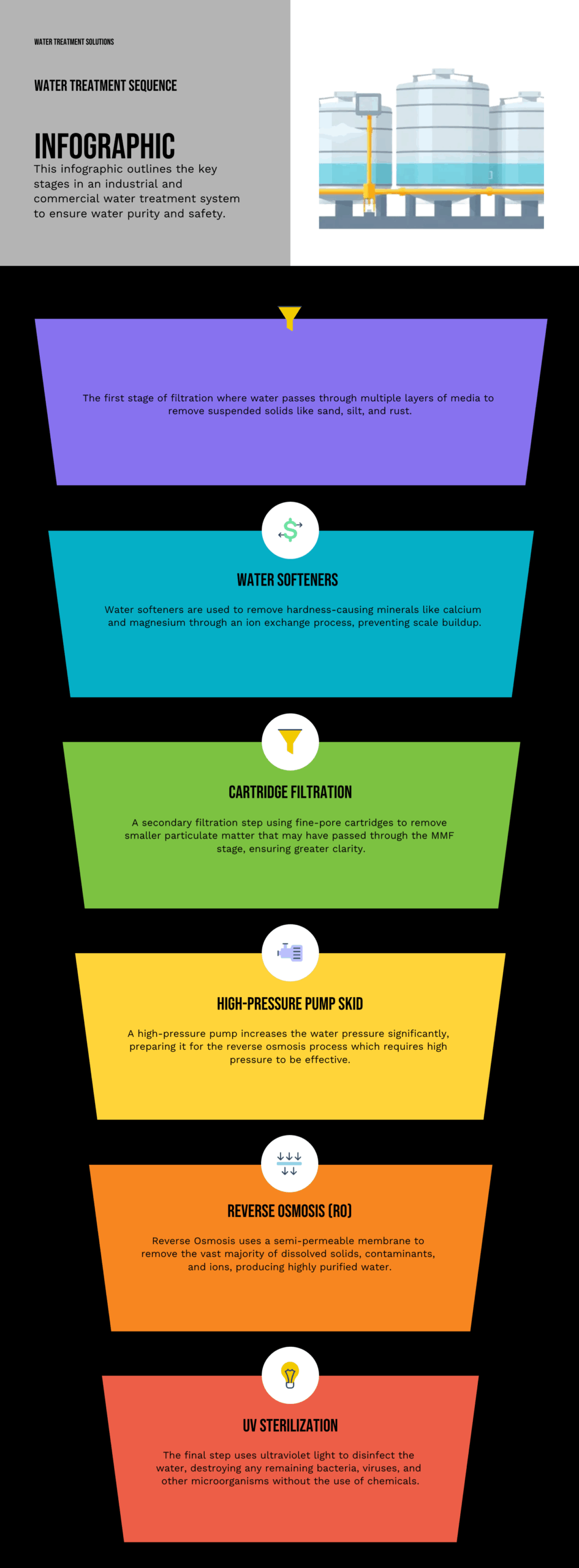
STEP 1: Multimedia Filtration (MMF)
Removes sediment, turbidity, and suspended solids.
STEP 2: Water Softeners (FRP Softeners)
Following MMF, a softener removes hardness minerals like calcium and magnesium, preventing scale formation on RO membranes.
STEP 3: Cartridge Filtration (typically 5 micron)
Final particulate removal before the high-pressure system.
STEP 4: Pump Skid System
Once pretreatment is complete, water enters the pump skid, which provides the necessary pressure to drive the RO membranes.
STEP 5: Reverse Osmosis Membranes
Water is separated across semipermeable membranes for high-purity output.
STEP 6: Optional Post-Treatment (UV)
For certain applications, UV Water Treatment provides microbiological protection.
Automation and Monitoring for MMF Systems
Many facilities rely on automated controls panels for pumps to manage backwashing cycles, regulate flow, and monitor pressure.
Automated control panels help:
-
Reduce manual operation
-
Ensure proper timing of backwash cycles
-
Prevent overloading the RO membranes
-
Provide system alarms and diagnostics
-
Track pressure loss across the MMF tank
Automation leads to more reliable operation and longer filter media life.
Benefits of Using Multimedia Filters in Industrial Applications
1. High Solids Removal Capacity
Depth filtration captures significantly more solids compared to surface-only filtration methods.
2. Longer Run Times Between Backwash Cycles
Because the filter bed holds more contaminants, maintenance intervals are extended.
3. Improved RO System Efficiency
Lower SDI levels create more stable inlet conditions, improving permeate flow and membrane performance.
4. Cost-Effective Over the Long Term
Reduced fouling, fewer cleaning cycles, and extended membrane life all lower total operational costs.
5. Versatile Across Multiple Industries
MMF systems benefit industries such as:
-
Power generation
-
Chemical processing
-
Food & beverage
-
Pharmaceutical manufacturing
-
Electronics
-
Hospitality and large facilities
-
Municipal water treatment
Wherever suspended solids are present, multimedia filtration is essential.
Why Multimedia Filters Are More Important Than Ever
Today’s industrial water treatment systems face increased regulatory scrutiny and heightened expectations for efficiency, sustainability, and reliability. As water quality declines in many regions and RO membranes become more advanced (and more expensive), a strong pretreatment strategy is critical.
Multimedia filtration remains one of the most effective and economical ways to protect industrial RO systems. Without it, even the best RO membranes will face premature failure and costly operational disruptions.
Final Thoughts: MMF Is the Foundation of Any Industrial RO Pretreatment System
From reducing turbidity to protecting high-pressure pumps and extending membrane life, multimedia filtration is the backbone of industrial RO pretreatment. When paired with proper softening, automated control panels, and well-designed pump skids, the entire RO system becomes more stable, more efficient, and more cost-effective.
ADVANCEES provides high-performance MMF systems engineered for industrial reliability, making them an essential component in any modern water treatment plant.


 ADVANCEES