
If you have requested quotes for new systems recently, you have likely noticed a sharp increase in pricing. The reality is simple. Industrial water treatment equipment costs in 2026 are rising, and tariffs are a major reason why.

For procurement managers, engineers, and CFOs, this shift is creating real challenges. Projects are being delayed. Budgets are being stretched. And long-term capital planning is becoming more unpredictable.

Understanding what is driving these cost increases and how to respond strategically is now critical.


Why Industrial Water Treatment Equipment Costs Are Rising in 2026

New tariffs implemented in early 2025 have directly impacted the global supply chain for water treatment systems.

Many key components used in reverse osmosis and filtration systems are sourced internationally. With tariffs applied, costs have increased across multiple categories, including:

  • Membrane elements and pressure vessels
  • Stainless steel and structural components
  • Pumps and energy recovery devices
  • Control panels and electronic components
  • Specialty filtration media and chemicals

These increases are not minor. In many cases, total system costs have risen between 25 and 30 percent compared to previous years.

For companies planning upgrades or new installations, this creates immediate financial pressure.


The Impact on Capital Projects and Compliance

Rising costs are affecting more than just procurement budgets. They are also impacting timelines and compliance requirements.

Many organizations rely on water treatment systems for:

  • Environmental compliance
  • Production continuity
  • Regulatory approvals
  • Water reuse and sustainability initiatives

When costs increase unexpectedly, companies are forced to:

  • Delay capital expenditures
  • Re-scope projects
  • Reduce system size or capacity
  • Postpone compliance upgrades

In regulated industries, delaying implementation is not always an option. This creates a gap between what is required and what is financially feasible.


What Components Are Driving the Biggest Price Increases

Not all parts of a system are affected equally. The most significant cost increases are coming from:

Imported Membranes and Filtration Components

Reverse osmosis membranes are one of the most critical parts of any system. Many of these are manufactured internationally, making them highly sensitive to tariff changes.

Structural and Fabrication Materials

Steel and specialty alloys used in skid-mounted and containerized systems have seen consistent price increases, impacting system build costs.

Electrical and Automation Systems

Control panels, PLCs, and instrumentation often rely on global supply chains. Tariffs and supply constraints have increased both cost and lead times.

Chemical Supply Chains

Antiscalants, cleaning chemicals, and specialty media are also affected, increasing long-term operating costs.

These combined factors are driving overall system pricing higher across the industry.


Why More Companies Are Turning to Leasing and Rental Systems

As industrial water treatment equipment costs continue to rise, many companies are shifting away from large upfront capital purchases.

Instead, they are exploring:

This shift is not just about cost. It is about flexibility and risk management.


The Financial Advantage of Leasing Water Treatment Systems

Leasing provides a strategic alternative to purchasing equipment in a volatile pricing environment.

Key advantages include:

  • Lower upfront capital investment
  • Predictable monthly operating costs
  • Faster deployment timelines
  • Reduced exposure to tariff-driven price increases
  • Included maintenance and system support

Rather than committing to a high-cost capital purchase during peak pricing conditions, companies can maintain operations while preserving cash flow.

For many organizations, this approach aligns better with current financial planning.


How ADVANCEES Helps Navigate Tariff-Driven Cost Increases

ADVANCEES provides flexible solutions designed to help companies adapt to rising equipment costs.

Lease Water Treatment Systems

Leasing allows facilities to deploy fully engineered systems without the burden of upfront capital expenditure. Systems are sized, installed, and supported by ADVANCEES engineers. Lease mobile Water RO Systems here.


Full Reverse Osmosis Product Range

For companies moving forward with capital projects, ADVANCEES offers a full range of:

Each system is designed for efficiency, scalability, and long-term performance.


Design and Consultancy Services

ADVANCEES works directly with clients to evaluate:

  • Water source quality
  • System sizing requirements
  • Cost optimization strategies
  • Long-term operational efficiency

This ensures that every system is engineered to meet both technical and financial goals.


What Procurement Teams Should Do Right Now

If your organization is planning a water treatment project in 2026, the best approach is proactive planning.

Focus on:

  • Evaluating total lifecycle cost, not just upfront price
  • Comparing leasing versus purchasing scenarios
  • Identifying areas where modular systems can reduce cost
  • Locking in pricing where possible before further increases
  • Working with domestic providers to reduce supply chain risk

Waiting for prices to stabilize may not be a viable strategy. The current trend suggests continued volatility.


Final Thoughts

Industrial water treatment equipment costs are rising, and tariffs are a major driver behind that increase.

For companies that rely on consistent, high-quality water, delaying action is not always an option. The key is adapting your strategy.

Leasing, modular systems, and expert system design provide a path forward that balances cost, performance, and operational reliability.

ADVANCEES is positioned to help organizations navigate this shift with flexible, scalable solutions built for today’s market conditions.
For manufacturing operations managers in Northern Ohio, few decisions carry more financial weight than how you acquire critical infrastructure. Water treatment is no exception. Whether your facility processes food and beverage, handles chemical production, or runs heavy industrial operations, consistent access to treated water directly affects output quality, equipment longevity, and regulatory standing.

The core question is not whether you need a water treatment system. You already know you do. The real question is whether purchasing that system outright makes more financial sense than operating it as a monthly expense. More manufacturers across the Midwest are turning to leased water treatment systems to protect capital, reduce risk, and keep operations running without the burden of ownership.

Here is a straightforward breakdown of what the numbers actually look like, and why the operational case for leasing is stronger than many operations managers initially expect.


The Cost Breakdown of Buying vs. Leasing

ROI of Leased vs. Owned Water Treatment Systems

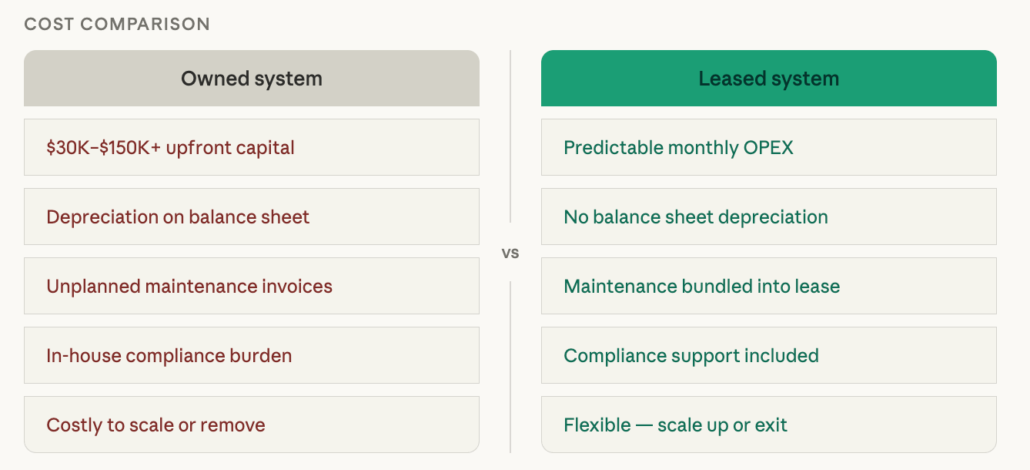
Purchasing a commercial or industrial reverse osmosis system outright requires a significant upfront capital expenditure. Depending on the capacity and configuration, a fully installed industrial RO system can range from $30,000 to well over $150,000 before factoring in installation, commissioning, and operator training.

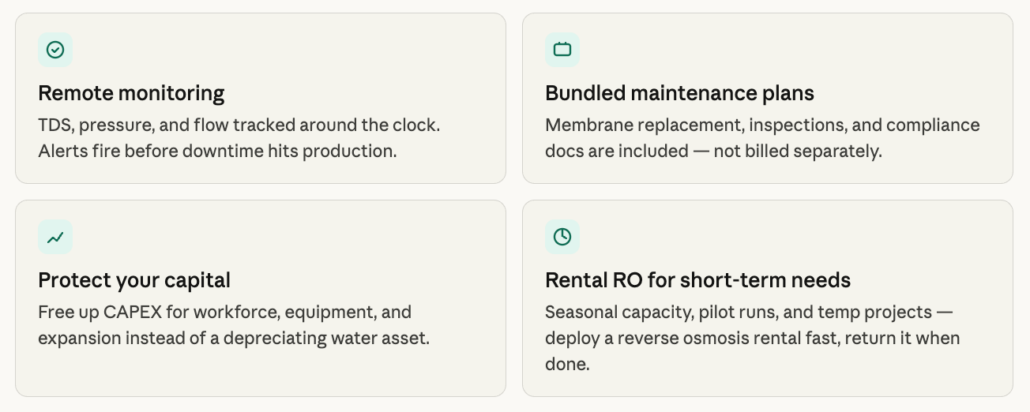
For small and mid-sized manufacturers, that CAPEX commitment competes directly with equipment upgrades, workforce investment, and production expansion. Tying up that capital in a water treatment asset that depreciates over time is a trade-off many facilities simply cannot afford to make.

Leasing converts that upfront cost into a predictable monthly operating expense. The best leased water treatment systems for manufacturing operational costs are structured so that the monthly payment covers the system, installation, and ongoing support. There are no surprise capital outlays, no large maintenance invoices, and no depreciation to account for on the balance sheet. For operations managers working within tight OPEX budgets, that predictability is not a minor convenience. It is a fundamental advantage.


Leased Water Treatment Systems with Remote Monitoring for Factories in Northern Ohio

One of the most underappreciated advantages of a modern lease agreement is what comes bundled with the system itself. Advanced leased water treatment systems remote monitoring for factories in Northern Ohio means your system is watched around the clock, not just when your maintenance technician happens to walk past it.

Remote monitoring platforms track critical performance metrics in real time, including TDS output, feed pressure, membrane flux rates, and flow volume. If the system deviates from acceptable parameters, an alert is triggered before a minor issue becomes a production stoppage.

For Northern Ohio manufacturers, where winter utility disruptions, hard well water, and high-TDS groundwater are common operational realities, that kind of visibility is a direct line to uptime. A reverse osmosis system running unmonitored in a second-shift or overnight operation is an operational liability. A remotely monitored leased system is not.


Maintenance Plans for Leased Industrial Water Treatment Systems

Ownership of an industrial water treatment system comes with full responsibility for keeping it compliant and operational. That means sourcing replacement membranes, scheduling preventive maintenance, managing consumables, and ensuring the system meets applicable discharge and water quality standards under Ohio EPA regulations.

Most in-house maintenance teams are not staffed or trained to handle this at scale. The result is deferred maintenance, reactive repairs, and compliance gaps that carry real financial and legal risk.

Maintenance plans for leased industrial water treatment systems eliminate that exposure entirely. Under a well-structured lease agreement, preventive maintenance, membrane replacement, system audits, and compliance documentation are bundled into the contract. Your team operates the system. Your provider keeps it performing. That division of responsibility is one of the clearest ROI arguments for leasing in a regulated manufacturing environment.


Flexibility for Short-Term Projects and Temporary Capacity Increases

Not every water treatment need is permanent. Seasonal production increases, contract manufacturing runs, facility expansions during construction, and pilot programs all create temporary demand for additional treated water capacity.

In these situations, a rental RO system is a far more practical solution than a capital purchase. A reverse osmosis rental can be deployed quickly, scaled to the specific output requirement, and removed when the project ends. There is no residual asset to manage, no resale headache, and no sunk cost when your capacity need changes.

For small and mid-sized manufacturers managing fluctuating production schedules, this flexibility is often the deciding factor. Affordable leased water treatment options for small businesses in the Midwest give operations teams the ability to respond to demand without committing to permanent infrastructure.


Why Leasing Makes Financial Sense for Northern Ohio Manufacturers

Why manufacturers in Northern Ohio choose to lease

Owning a water treatment system is not inherently wrong. For large-scale facilities with dedicated engineering staff and long asset depreciation horizons, it can make sense. However, for the majority of small and mid-sized manufacturers in Northern Ohio, the math consistently favors leasing.

Lower upfront costs, bundled maintenance, remote monitoring, regulatory compliance support, and the flexibility to scale up or down all contribute to a stronger ROI profile than outright ownership delivers. When you factor in the total cost of ownership versus the total cost of operation, leasing is not the budget option. It is the smarter one.

Contact ADVANCEES today to discuss a leased water treatment solution built around your facility’s specific flow requirements, water source conditions, and operational budget.