
Electrodeionization Systems for High-Purity Industrial Water Treatment
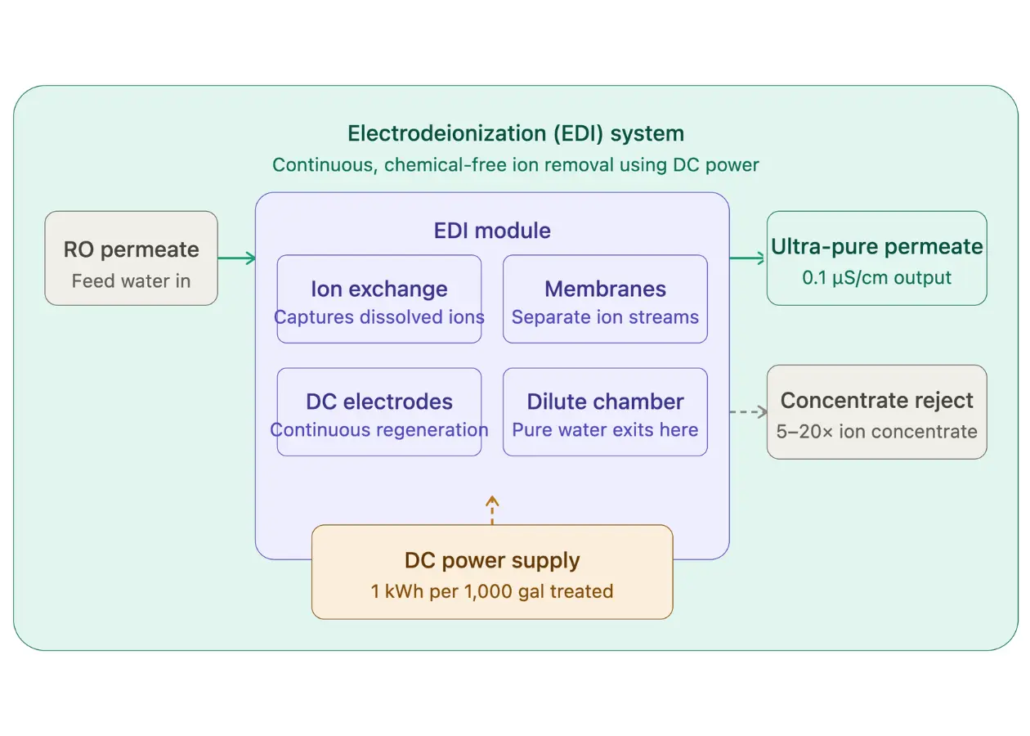
An electrodeionization system is a continuous, chemical-free water purification technology that removes ionized and ionizable dissolved species from feed water using DC electrical current. Electrodeionization (EDI) is used primarily to polish reverse osmosis permeate to ultra-low conductivity levels, replacing conventional mixed bed ion exchange in applications where consistent, high-purity water is a process requirement.
ADVANCEES EDI systems deliver reliable, continuous purification without chemical regeneration inputs, making them the preferred solution for pharmaceutical, power generation, microelectronics, and high-purity industrial operations.
How an Electrodeionization System Works
EDI combines ion exchange resin beds with semi-permeable membranes and a direct current electrical field. Dissolved ions migrate through the resin and membranes toward oppositely charged electrodes, continuously purifying the water stream.
Unlike conventional deionization, which operates as a batch process and requires periodic acid and caustic regeneration, an EDI system regenerates electrochemically and continuously as long as DC voltage is applied. The result is consistent product water quality from the first gallon to the last, with no degradation over time and no regeneration downtime.
Key Advantages of EDI Over Conventional Deionization
No Chemical Regeneration Required
Conventional mixed bed deionizers require acid and caustic regeneration at regular intervals. Those chemicals carry purchase costs, storage requirements, handling risks, and EPA and OSHA compliance obligations. An electrodeionization system eliminates all of it.
The electrical consumption required to replace chemical regeneration is minimal. A typical EDI system uses approximately 1 kWh of electricity to deionize 1,000 gallons of water from 50 µS/cm feed conductivity to 0.1 µS/cm product conductivity.
Continuous Operation, No Duplexing Needed
Conventional deionization systems serving continuous processes must be duplexed, meaning two systems are installed so one can operate while the other regenerates. Duplexing doubles capital cost, doubles footprint, and adds operational complexity.
Because an electrodeionization system operates continuously without regeneration interruption, duplexing is not required. EDI system footprints are typically half the size of equivalent conventional deionizer installations.
Consistent Product Water Quality
In conventional deionization, product water quality degrades progressively as the resin approaches exhaustion. An EDI system maintains consistent output conductivity throughout operation because electrochemical regeneration occurs continuously within the device. For processes with strict purity specifications, that consistency is not optional.
Reduced Facility Costs
Eliminating chemical regeneration also eliminates the infrastructure required to support it. Acid storage tanks, caustic storage, fume ventilation, waste neutralization equipment, and chemical handling areas are all unnecessary with an EDI system. Facility costs and regulatory compliance burden both decrease as a direct result.
EDI Pretreatment Requirements
EDI systems have stricter feed water requirements than conventional demineralizers. Because electrochemical regeneration does not provide the same level of resin cleaning that chemical regeneration delivers, proper pretreatment is essential to prevent membrane and resin fouling.
Reverse osmosis pretreatment is required upstream of every electrodeionization system. RO removes the bulk of dissolved solids before feed water enters the EDI unit, protecting the membranes and resins from fouling and scaling.
For brackish water feed sources, an ADVANCEES MBWRO Series system upstream of the EDI unit provides the correct pretreatment and ensures consistent EDI feed water quality across varying source water conditions.
Industries That Use Electrodeionization Systems
EDI is the standard technology for ultra-low conductivity water production in regulated and high-purity industrial sectors. Common applications include:
- Biopharmaceutical and pharmaceutical manufacturing where USP purified water and water for injection (WFI) specifications require consistent sub-0.1 µS/cm conductivity.
- Power generation and boiler feed water where ultra-low conductivity feed water protects high-pressure turbines and heat exchangers from mineral deposition.
- Microelectronics and semiconductor fabrication where ultrapure water is required for wafer rinsing and process chemistry at sub-parts-per-billion dissolved solids concentrations
- Laboratory and research facilities where ASTM Type I and Type II water standards require consistent, verified purity.
- Chemical processing where process water purity directly affects reaction outcomes, product consistency, and yield.
Request a Quote for Your Electrodeionization System
If your application requires continuous high-purity water production without the cost, complexity, and compliance burden of chemical regeneration, an ADVANCEES electrodeionization system is the right solution.
Contact ADVANCEES today to discuss your feed water conditions, output purity requirements, and daily flow volume. Our engineering team will specify the right EDI system and RO pretreatment configuration for your application.


 ADVANCEES